Missouri's four-year graduation pipeline expanded from 2019 to 2025. The cohort grew, the graduation rate rose and the number of students who did not graduate on time fell.
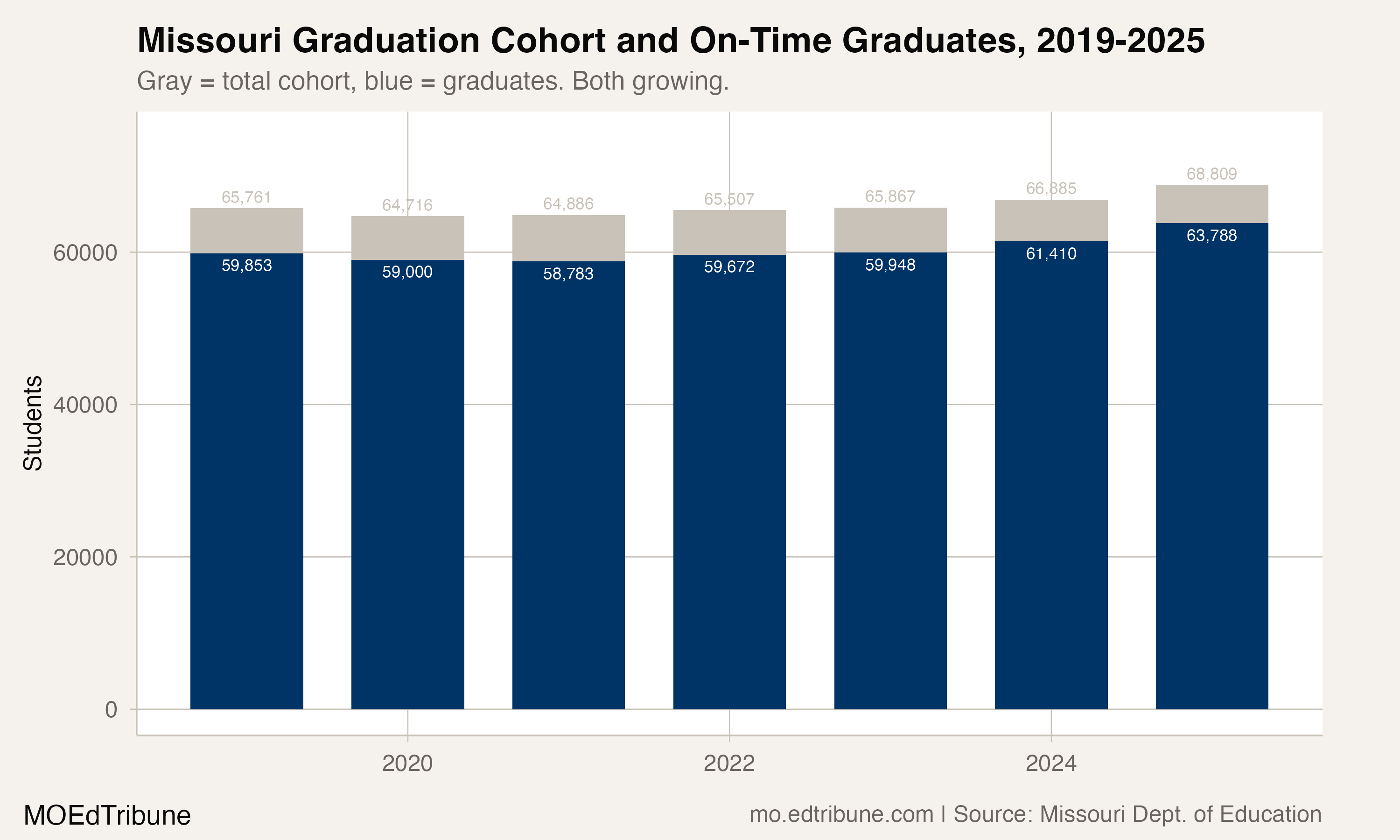
The state's four-year graduating cohort grew from 65,761 students in 2019 to 68,809 in 2025, an increase of 3,048 students. Combined with the rising graduation rate, from 91.0 percent to 92.7 percent, this means Missouri produced 63,788 on-time graduates in 2025 compared with 59,853 in 2019. That is 3,935 additional graduates per year, a 6.6 percent increase.
An illustrative comparison
Rate improvement and cohort growth are multiplicative. If the rate had stayed at 91.0 percent while the cohort grew to 68,809, Missouri would have produced 62,616 graduates, a gain of 2,763 from rate-holding alone. The observed graduate count is 1,172 above that illustrative calculation. This uses the rounded rate stated here; it does not identify why individual students graduated. Rate and cohort together produce a gain larger than either would alone.
Fewer non-graduates despite more students
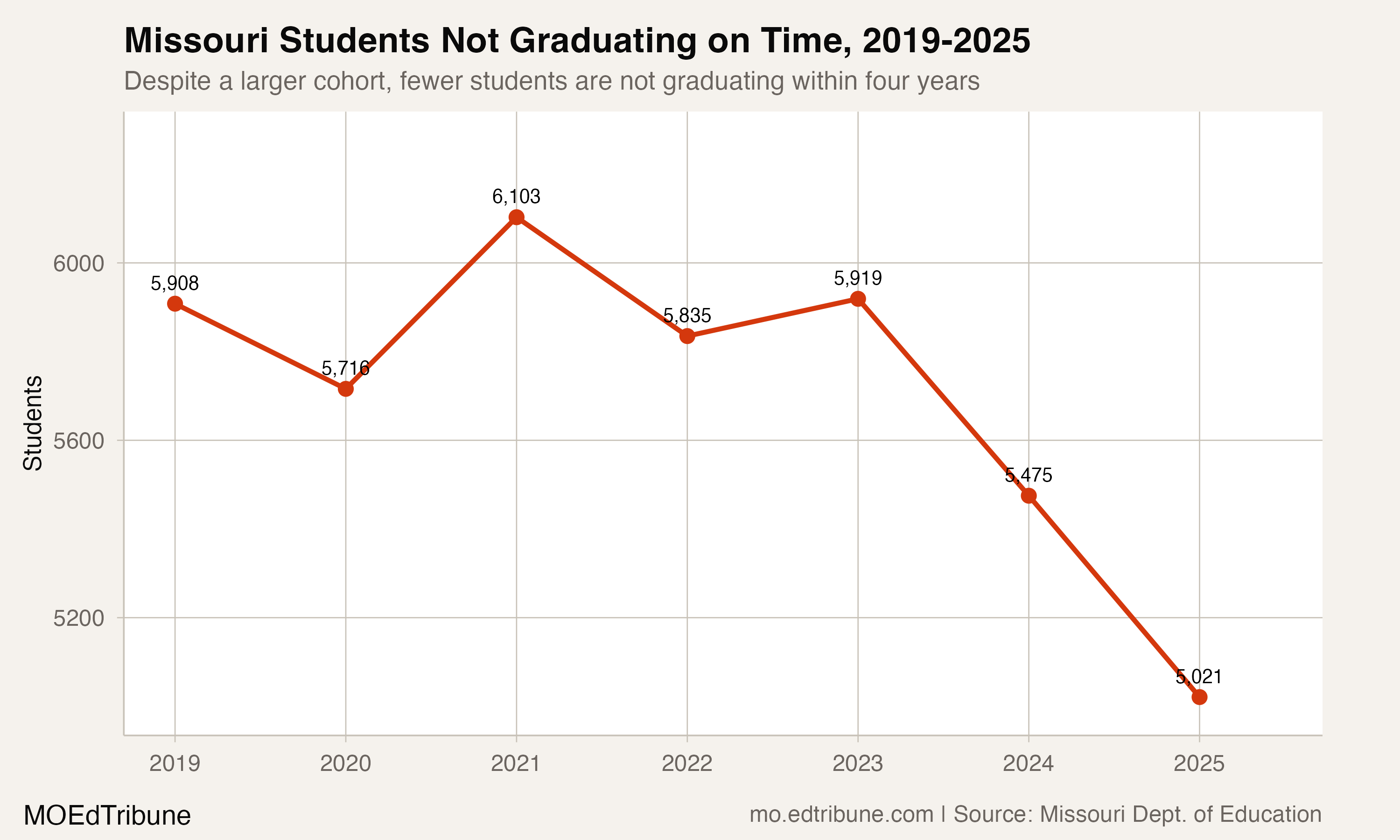
The flip side of producing more graduates from a larger cohort is that Missouri is also producing fewer non-graduates. In 2019, 5,908 students in the cohort did not graduate in four years. In 2025, that number fell to 5,021 despite a larger total cohort. The published cohort counts show more graduates and fewer students missing the four-year milestone; they do not establish the reasons.
Where the growth is
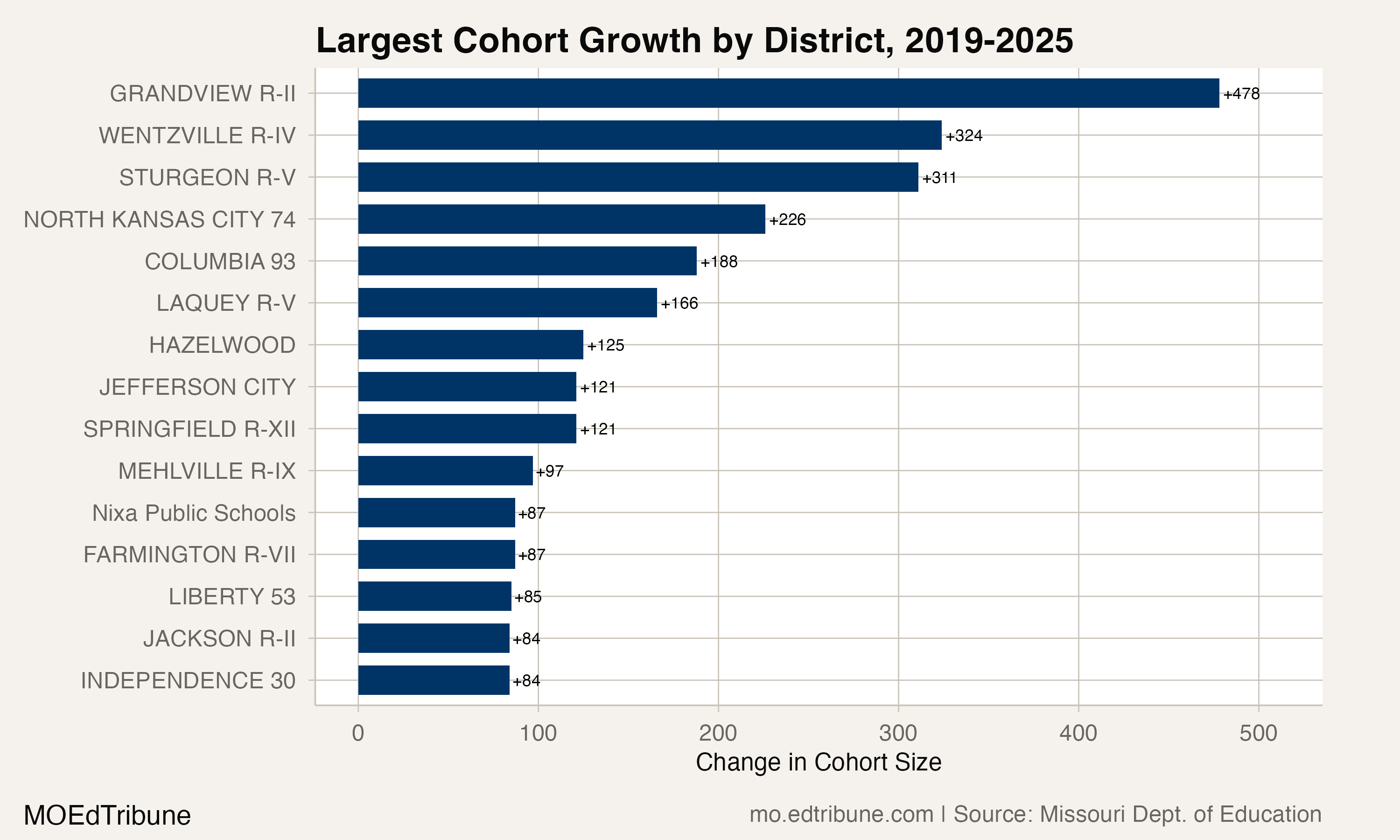
The cohort growth is not evenly distributed. Among districts with published cohort counts in both years, the largest increase belongs to Grandview R-II, whose four-year cohort went from 57 students to 535. Sturgeon R-V added 311 and Laquey R-V added 166. All three had comparatively small enrollments in 2019 and more than tripled their published kindergarten-through-12th-grade enrollment by 2025, excluding preschool. Between them they account for 955 students, or 31 percent, of the state's entire cohort growth.
Other measured cohort gains were smaller. Wentzville R-IV added 324 students, the second-largest increase in that matched comparison, and North Kansas City School District added 226. Springfield R-XII added 121. Some districts saw their cohorts shrink, led by St. Louis City (down 287 students), Fort Zumwalt (down 149), and the Special School District of St. Louis County (down 146).
Growing and improving do not travel together. Across the 234 districts with a 2019 cohort of at least 50 students, the relationship between cohort growth and change in graduation rate is close to zero, and districts whose cohorts shrank raised their rates slightly more on average than districts whose cohorts grew. Wentzville R-IV ended 2025 a fraction of a point below its 2019 rate. Grandview R-II graduated 68.8 percent of its 2025 cohort and Laquey R-V graduated 54.1 percent, both well below the state's 92.7 percent.
The statewide result above uses the state's published cohort and graduate totals. District records with missing counts cannot establish an exact graduation rate for the rest of the state after excluding those three districts.
Analysis based on graduation data from the Missouri Department of Elementary and Secondary Education.
Detailed code that reproduces the analysis and figures in this article is available exclusively to EdTribune subscribers.
Discussion
Sign in to join the discussion.
Loading comments...