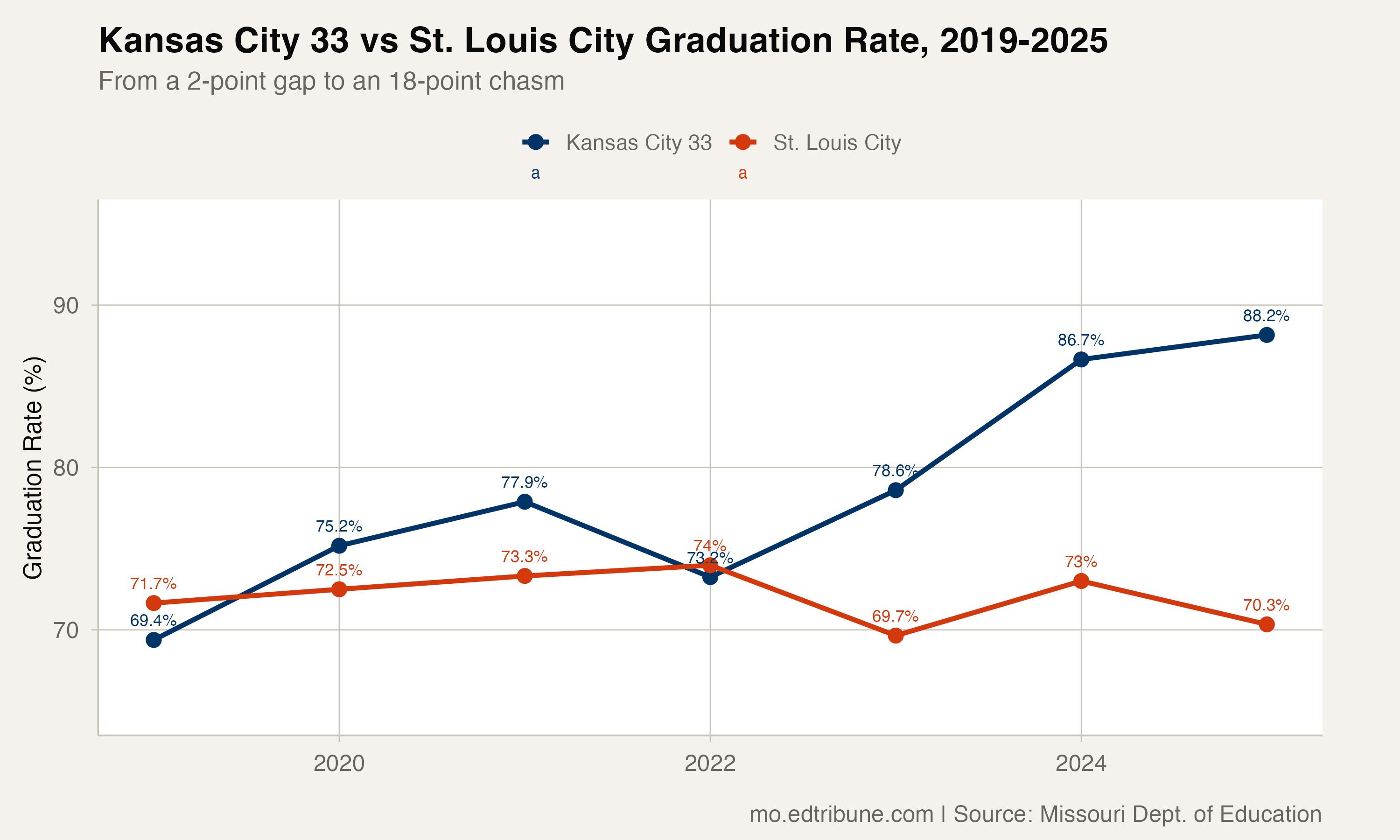
In 2019, Kansas City 33↗ET graduated 69.4 percent of its four-year cohort. St. Louis City↗ET graduated 71.7 percent. The two districts, Missouri's largest urban systems, were separated by 2.3 percentage points, both struggling below 75 percent, both provisionally accredited, both grappling with poverty, enrollment loss, and administrative instability.
By 2025, the gap between them had blown open to 17.8 points. Kansas City climbed to 88.2 percent. St. Louis fell to 70.3 percent. Two cities that once shared a common crisis now occupy different universes.
The divergence among Black students
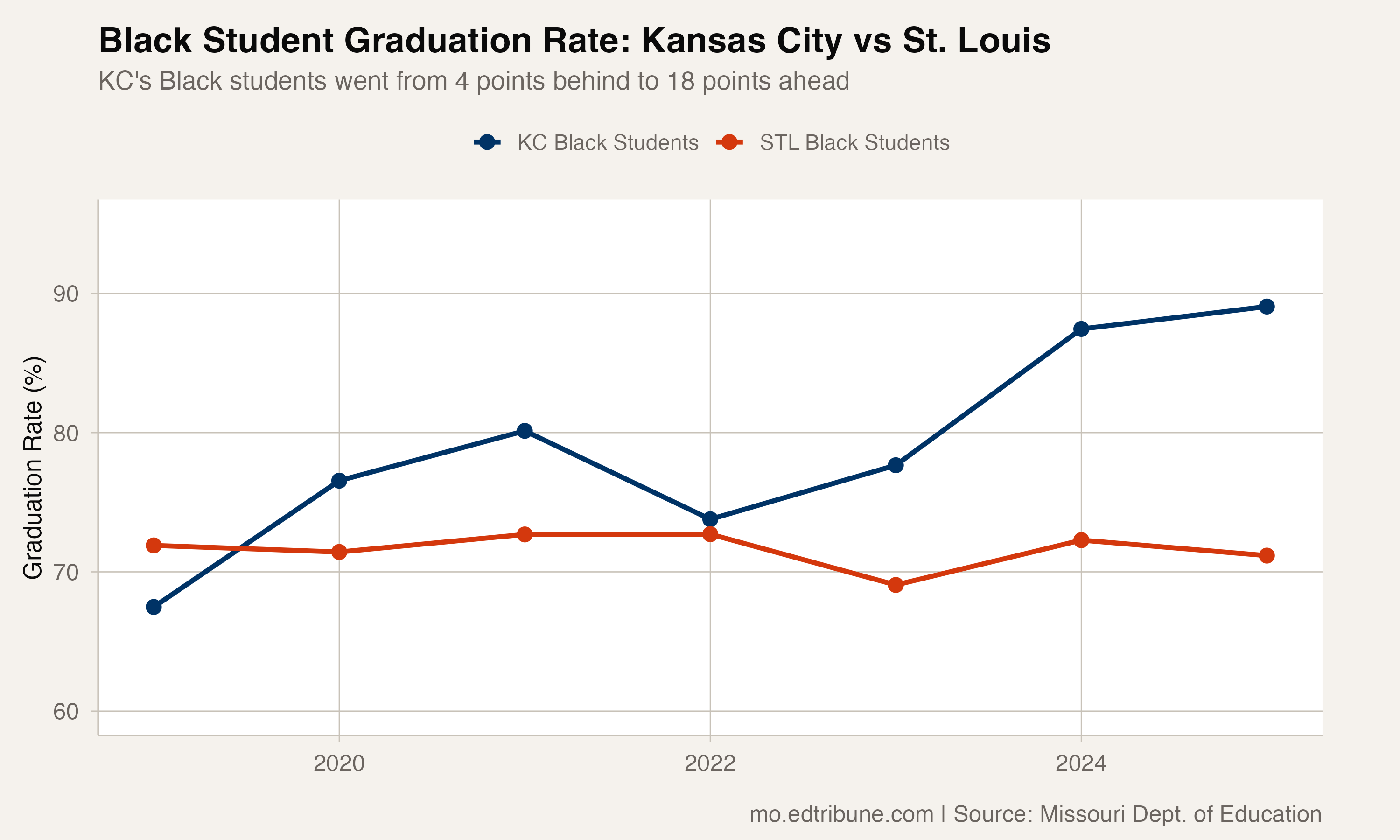
The split is even starker among Black students. In 2019, Black students in St. Louis graduated at 71.9 percent, actually 4.4 points higher than Black students in Kansas City at 67.5 percent. St. Louis was winning this comparison.
Six years later, Black students in Kansas City graduate at 89.1 percent. In St. Louis, 71.2 percent. The gap reversed completely, flipping from a 4.4-point St. Louis advantage to an 17.9-point Kansas City advantage. Kansas City's Black graduation rate now exceeds St. Louis's overall rate for all students.
Every subgroup, same story
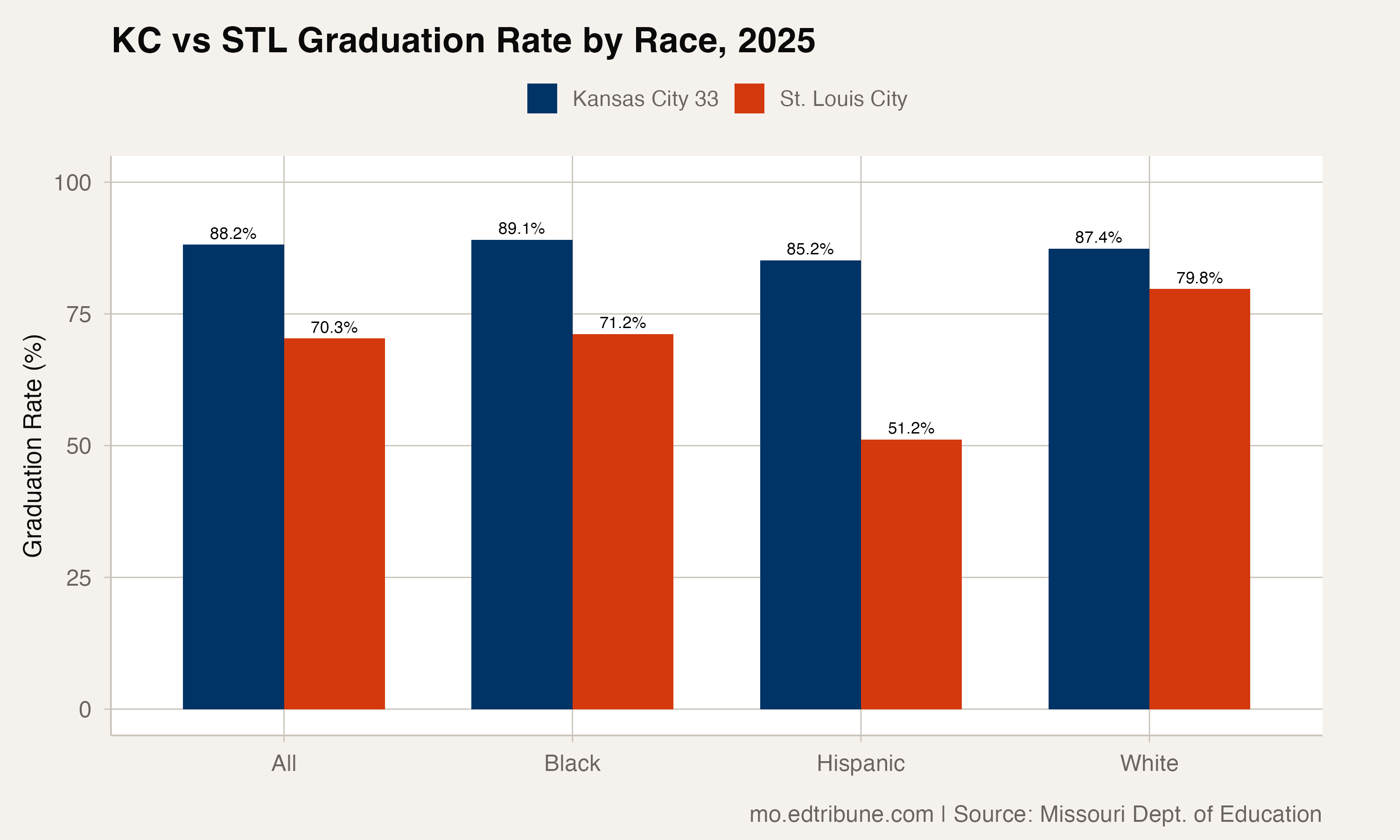
The divergence is not confined to a single demographic group. In 2025, Kansas City outperformed St. Louis in every racial category. The overall gap of 17.8 points is mirrored across subgroups, though the magnitude varies. Hispanic students show the widest spread, with KC at 85.2 percent and STL at 51.2 percent, a gap of 34 points.
Why it happened
The answer is not that one city got richer and the other got poorer. Both KC and STL serve high-poverty student populations. Both lost enrollment over the period. Both faced the same pandemic disruptions.
The difference is trajectory. Kansas City 33 staged one of the most dramatic graduation rate turnarounds in the state's history, gaining 18.8 points over six years through what the district describes as sustained investment in student supports, attendance interventions, and credit recovery programs.
St. Louis, by contrast, has been trapped in a narrow band between 69.7 and 74.0 percent for the entire data window. The district is provisionally accredited and has faced persistent leadership turnover. Its Hispanic graduation rate has collapsed by 14.6 points, and its cohort has shrunk by 287 students.
What it means
The KC-STL divergence is now the defining story of Missouri education. Two cities that started in the same place arrived at dramatically different outcomes over the same six-year period. Kansas City demonstrated that deep improvement is possible in a high-poverty urban district. St. Louis demonstrated that it is not inevitable.
Detailed code that reproduces the analysis and figures in this article is available exclusively to EdTribune subscribers.
Discussion
Sign in to join the discussion.
Loading comments...