Missouri's graduation surge is not a story confined to a few high-profile districts. In 2025, 179 of the state's 455 districts posted their highest four-year graduation rate on record, a share of 39.3 percent. Nearly four in ten districts are at their best-ever mark.
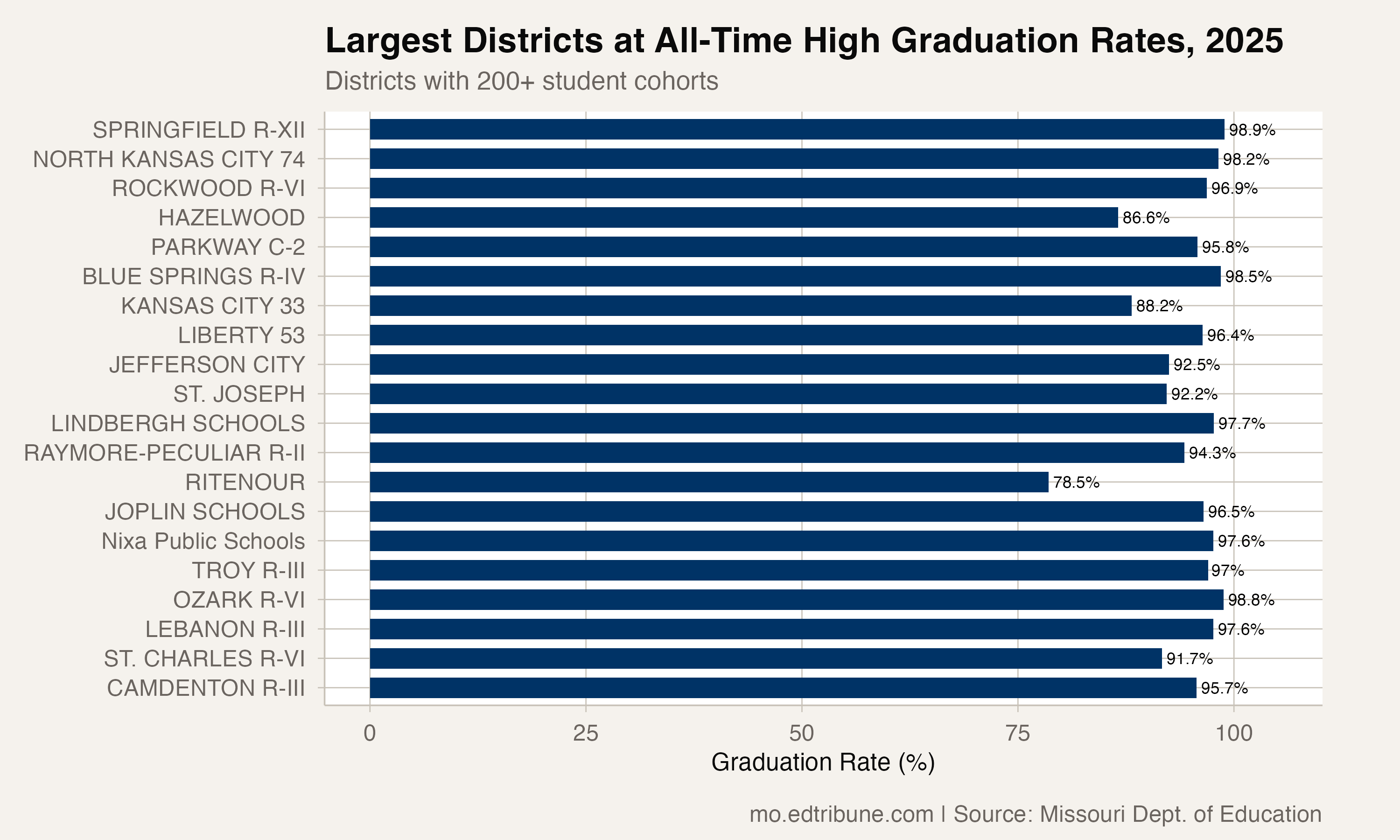
The record-setters include large districts with substantial cohorts: Springfield R-XII↗ET at 98.9 percent with 2,017 students, Blue Springs R-IV↗ET at 98.5 percent with 1,172 students, and North Kansas City 74↗ET at 98.2 percent with 1,727 students. Thirteen districts achieved a perfect 100 percent rate with cohorts of at least 50 students.
The other end
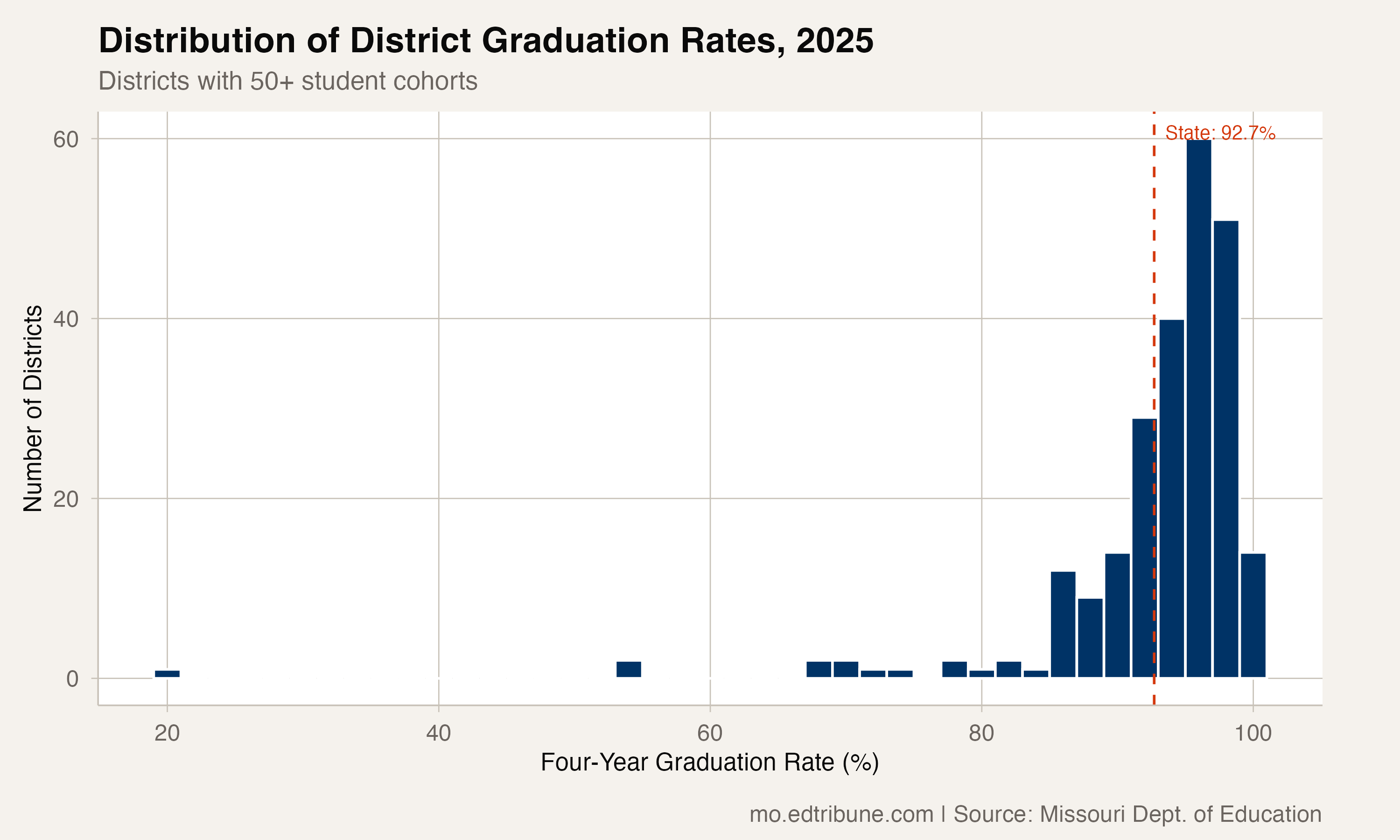
While 179 districts sit at all-time highs, 50 districts posted their lowest rate in the data window, a share of 11.0 percent. The ratio of districts at highs to districts at lows is roughly 3.6 to 1, a strong signal that the statewide improvement is broad-based rather than driven by a few outliers pulling the average up.
Among districts with meaningful cohort sizes, the vast majority are clustered above 90 percent. The distribution shows a long left tail of struggling districts and a dense concentration near the top.
Who is setting records
The largest districts at all-time highs represent a cross-section of Missouri's geography and demographics. Suburban Kansas City districts, St. Louis County districts, outstate communities, and mid-size cities all appear on the list. The breadth matters because it rules out the possibility that the state record is a statistical artifact of a few turnarounds.
Above 95 percent
One hundred twenty-five districts with cohorts of at least 50 students graduated 95 percent or more of their students in 2025. That is a staggering concentration of success. It means that in more than a quarter of Missouri's districts, only a handful of students in each cohort fail to finish on time.
The number above 95 percent has grown steadily over the data window, driven by incremental improvements at districts that were already performing well. The state's gains are coming from the middle and top of the distribution compressing upward, not just from turnarounds at the bottom.
The persistent gap
Among the lowest-performing districts in 2025, several are urban and high-poverty. St. Louis City↗ET graduated 70.3 percent of its cohort, Grandview C-4↗ET 72.5 percent (its own lowest mark in the data window), and Normandy Schools Collaborative↗ET 73.3 percent. The gap between the highest and lowest districts in Missouri spans nearly 80 percentage points when including the Special School District of St. Louis County (19.2 percent, a special education district).
Missouri's graduation story is overwhelmingly positive, but the concentration of struggling districts in a small number of urban communities means the state's gains are unevenly shared.
Detailed code that reproduces the analysis and figures in this article is available exclusively to EdTribune subscribers.
Discussion
Sign in to join the discussion.
Loading comments...