Correction (November 13, 2026): An earlier version used incomplete district counts to calculate Missouri's statewide graduation rates and described Kansas City's improvement as one of the largest in state history without establishing a historical rank. The Missouri State Report Card rates put the district 20.2 points below the state in 2019 and 3.3 points below in 2025. The district's published results are unchanged.
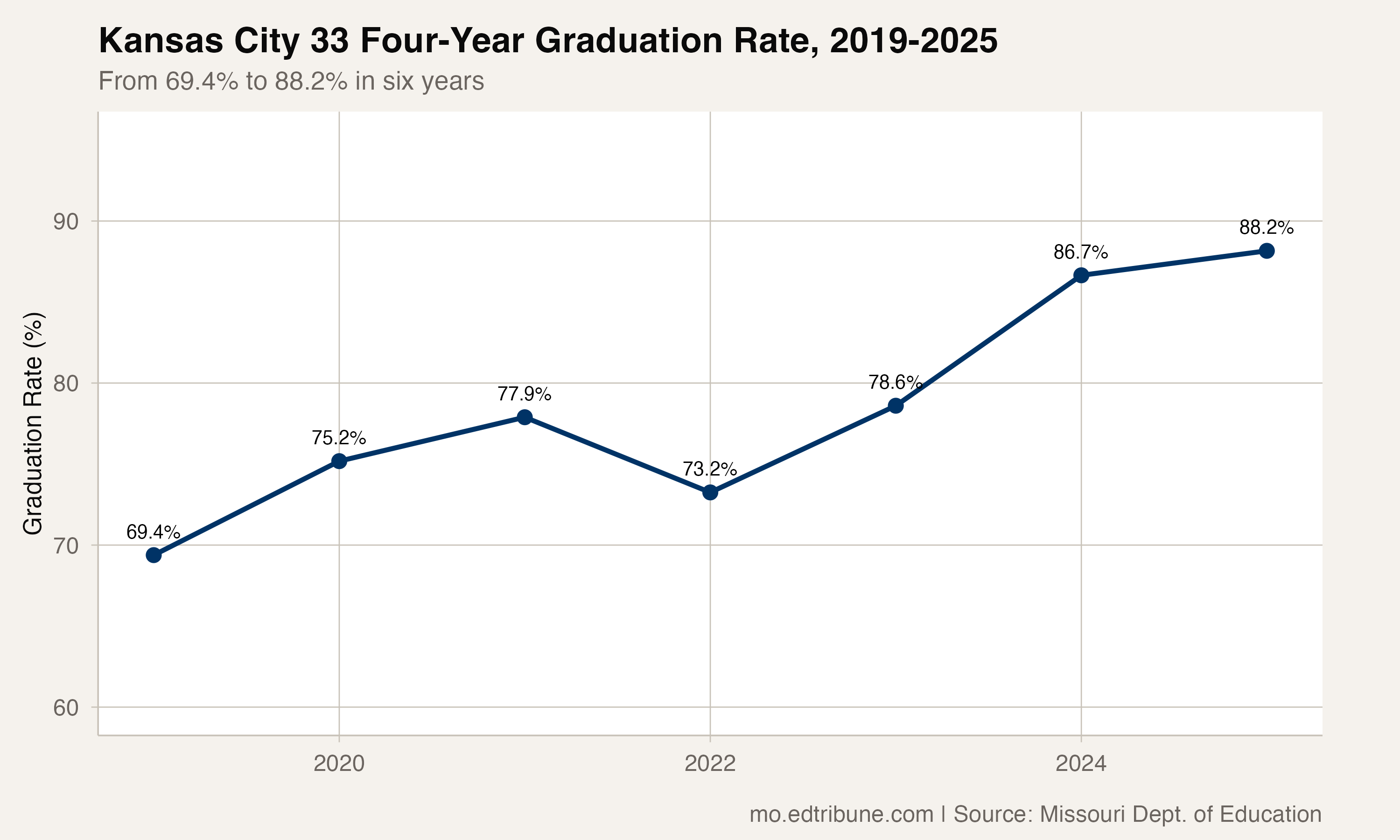
In 2019, barely seven of every ten students in Kansas City 33↗ET graduated on time. The district's 69.4 percent four-year rate was below St. Louis City's. Six years later, 88.2 percent of Kansas City 33 students graduated on time, an increase of 18.8 percentage points.
Kansas City 33 climbed to 77.9 percent by 2021, then fell back to 73.3 percent in 2022. The district gained 5.4 points in 2023, 8.1 points in 2024 and another 1.5 in 2025.
The rate for Black students rose faster than the district's
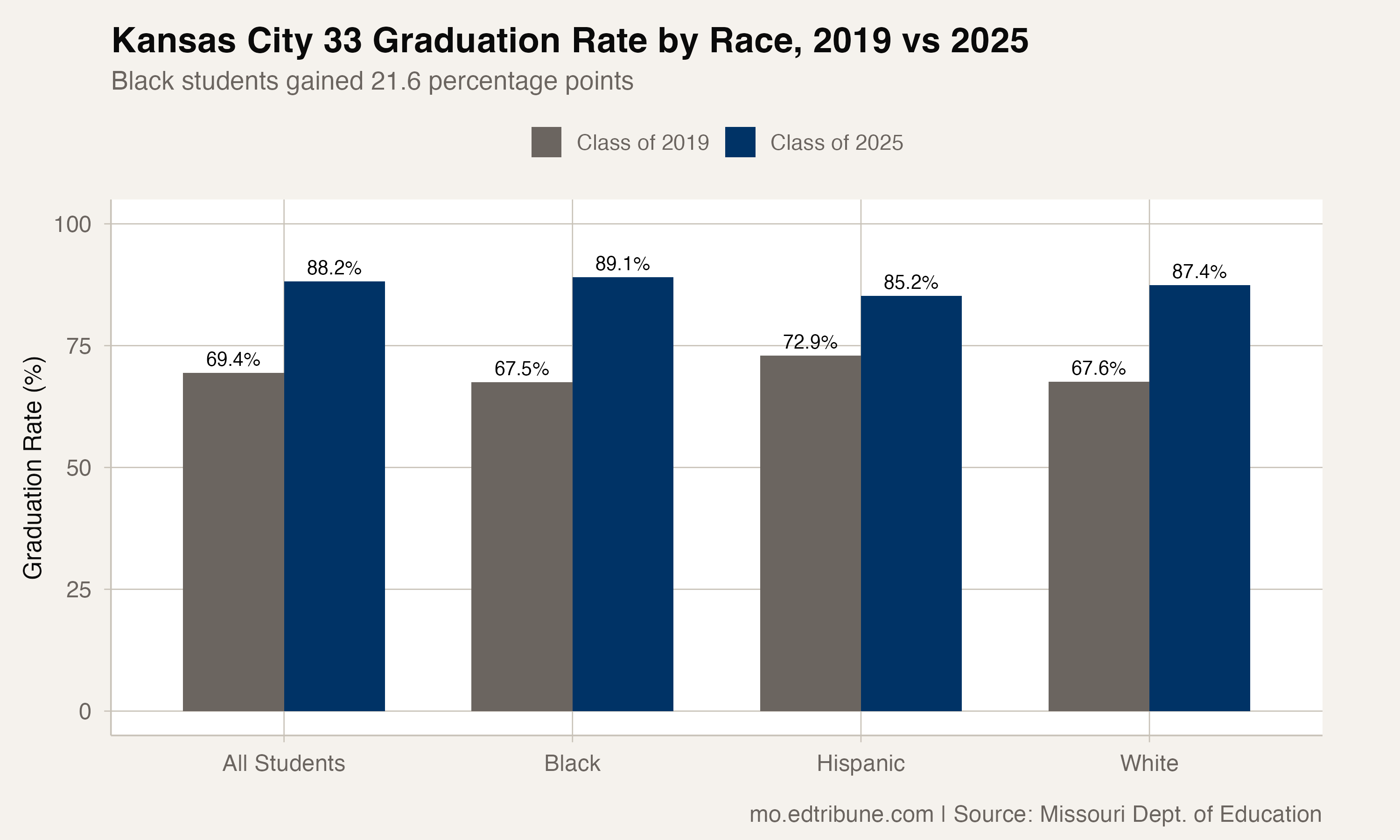
Black students in Kansas City 33 graduated at 67.5 percent in 2019. By 2025, that rate had reached 89.1 percent, a 21.6 percentage point gain that outpaced the overall district improvement. In 2025 their rate was above the districtwide rate.
The Hispanic graduation rate climbed from 72.9 percent to 85.2 percent, a gain of 12.3 points.
Closing the gap with the state
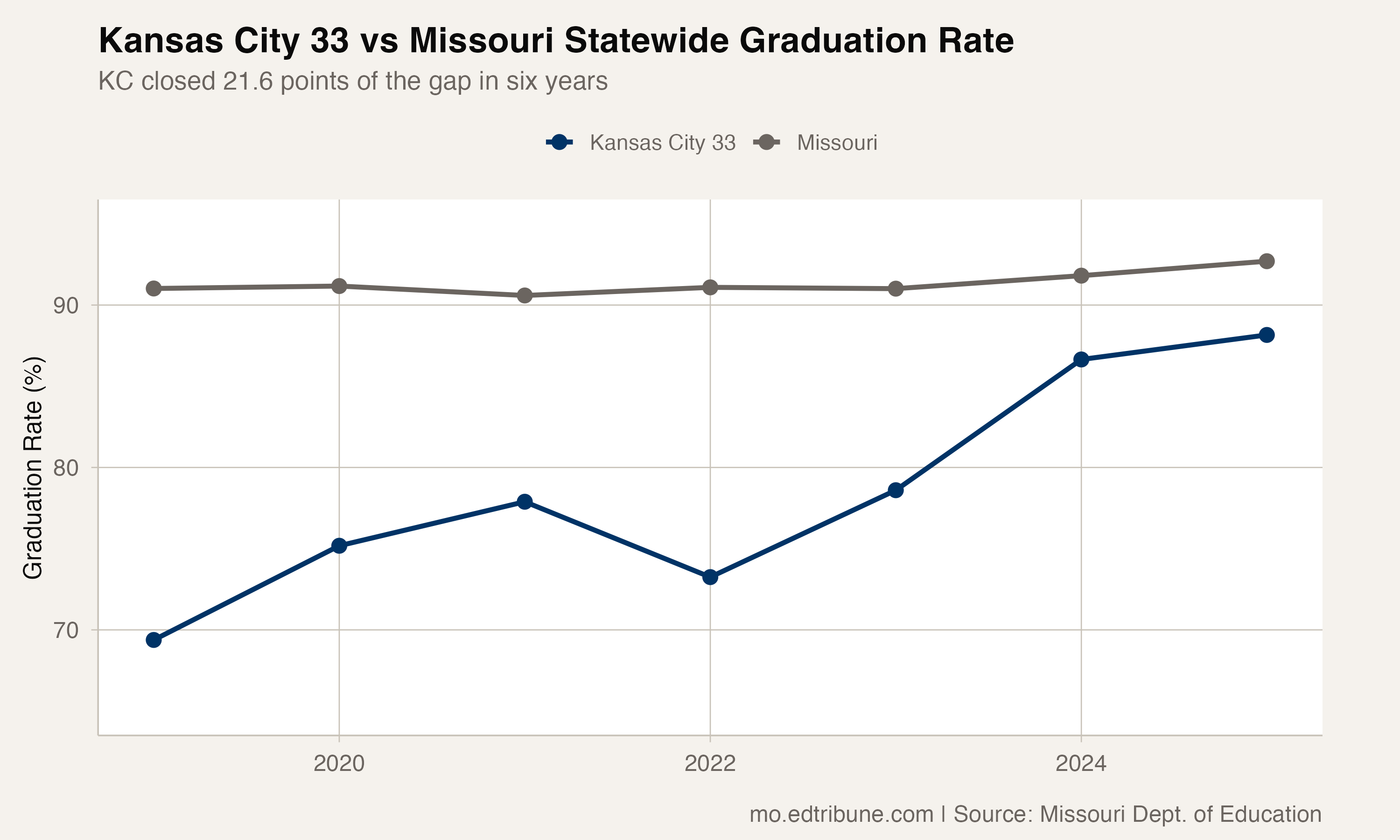
In 2019, Kansas City 33's rate was 20.2 points below Missouri's published rate of 89.6 percent. By 2025, Missouri was at 91.4 percent and the gap had narrowed to 3.3 points. Kansas City 33 closed 16.9 percentage points of that gap.
Kansas City 33's 2025 four-year cohort had 1,081 students.
What remains
Of those students, 128 did not graduate on time. Kansas City 33's 2025 rate also trailed Blue Springs (98.5 percent) and North Kansas City (98.2 percent).
The 2022 setback, when the rate dropped 4.6 points, came before a 14.9-point rise from 2022 to 2025. The graduation records show the turnaround. They do not identify what changed inside the district or whether the gains will last.
District results come from the Missouri Department of Elementary and Secondary Education. Statewide rates come from the Missouri State Report Card figures reproduced in the PRiME Center's master data workbook.
Detailed code that reproduces the analysis and figures in this article is available exclusively to EdTribune subscribers.
Discussion
Sign in to join the discussion.
Loading comments...