Correction (September 19, 2026): An earlier version of this article said St. Louis City's Black students graduate 18 points below the statewide rate for Black students; the two rates it reported, 71.2% and 86.7%, are 15.5 points apart. It put the Hispanic rate's decline at 14.6 points; its own figures, 65.7% and 51.2%, give 14.5. It also said the district's Hispanic graduation rate fell in five of six years with a partial recovery in 2024. The rate fell in four of the six years, including each of the last three, and rose in 2020 and 2022. The earlier version also described the district's poverty rate, accreditation status and pandemic learning loss without citing a source, and described enrollment shares that graduation data cannot show; those statements have been removed. The headline has been revised to state the two rates.
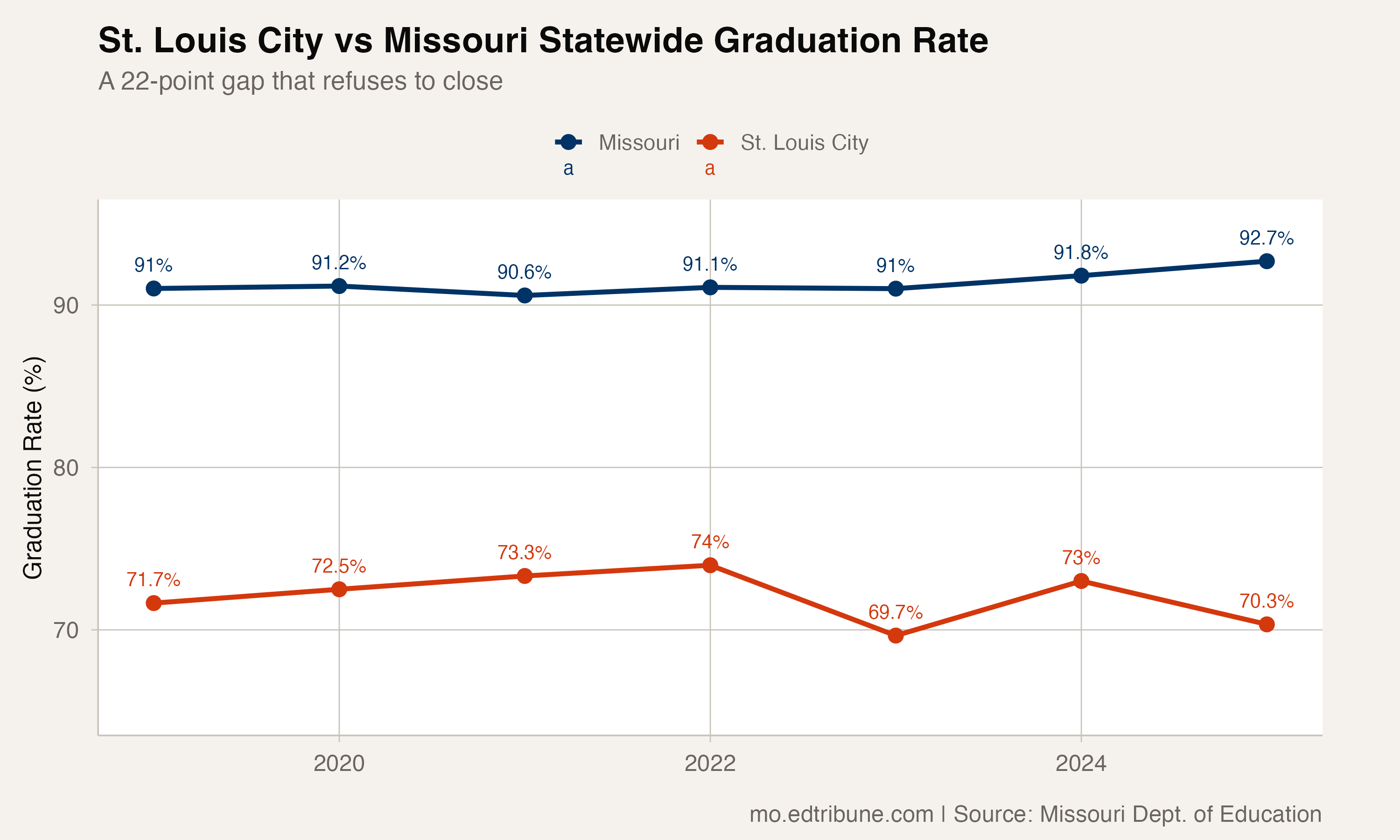
Missouri's statewide graduation rate reached 92.7 percent in 2025, the highest in the state's reporting since 2019. St. Louis City↗ET graduated 70.3 percent of its students that same year.
The 22.4 percentage point gap between St. Louis and the state is the largest among Missouri's 12 districts with the biggest graduating classes. It is wider than the gap between Kansas City 33 and the state, and wider than St. Louis's own 19.4-point gap in 2019.
Since 2019, St. Louis City's graduation rate has moved in a narrow band between 69.7 percent and 74.0 percent, ending 2025 close to where it started. The state's rate rose over the same years. St. Louis's did not.
A falling Hispanic rate
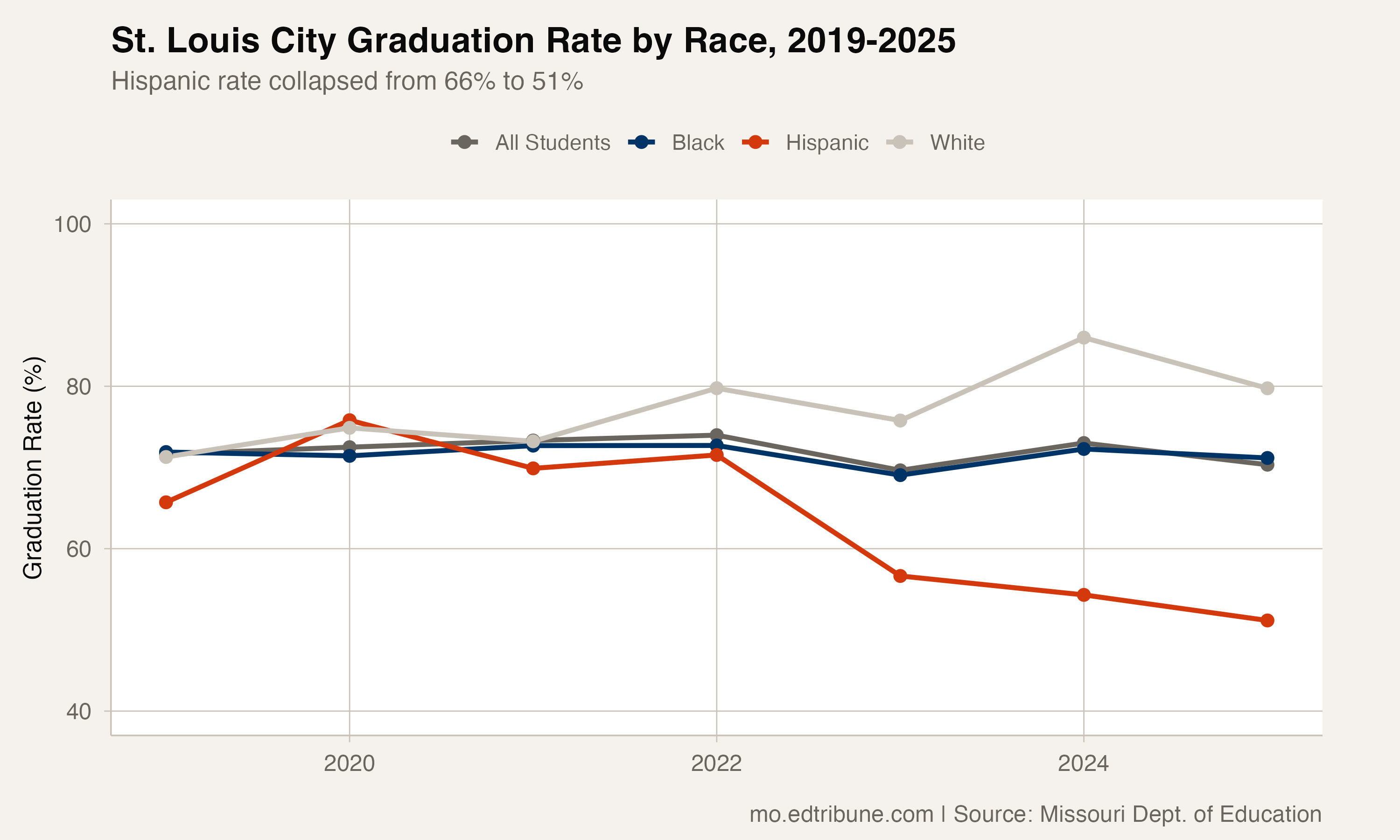
The sharpest trend in St. Louis is not the overall stagnation. It is the decline in the Hispanic graduation rate. In 2019, 65.7 percent of Hispanic students in St. Louis graduated on time. By 2025, that figure had fallen to 51.2 percent, a decline of 14.5 percentage points. Barely half of the district's Hispanic students finished high school in four years.
The path was not a straight line. The rate rose in 2020 and again in 2022, then fell in each of the last three years; across the six year-to-year changes, it fell in four. The Hispanic cohort is small, which makes single-year rates move more, but it has grown, from 105 students in 2019 to 172 in 2025.
Black students in St. Louis graduated at 71.2 percent, 15.5 points below the statewide Black rate of 86.7 percent. White students graduated at 79.8 percent, 14.7 points below the statewide white rate.
A shrinking pipeline
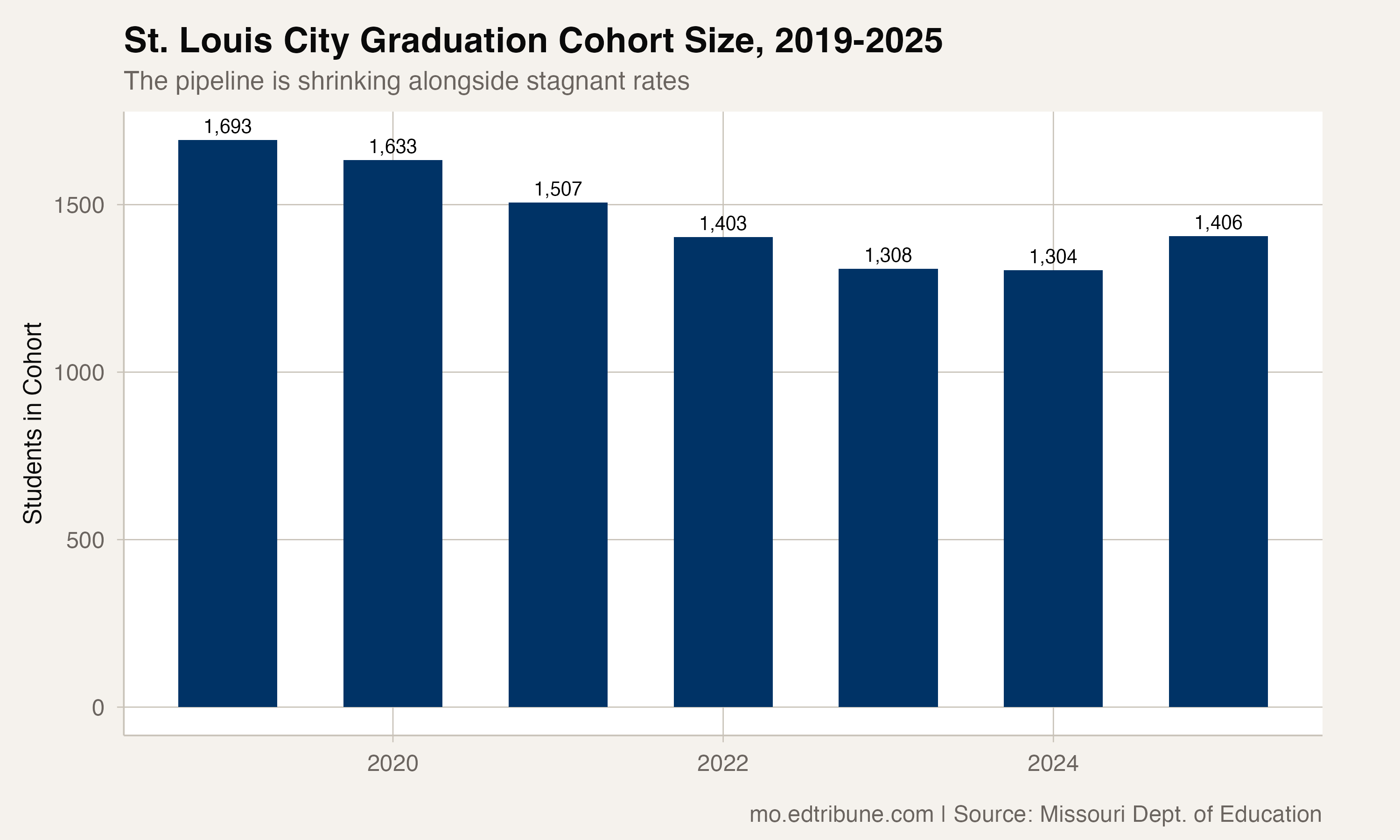
The district's cohort is also contracting. In 2019, St. Louis had 1,693 students in its four-year graduating class. By 2025, that number had fallen to 1,406, a loss of 287 students. The smaller cohort means fewer students in total are not graduating, but the rate itself has not moved much.
At 70.3 percent and 1,406 students, 417 students in St. Louis City's 2025 cohort did not graduate on time.
Two cities, two paths
The contrast with Kansas City 33, which climbed from 69.4 percent to 88.2 percent over the same period, makes the stagnation starker. In 2019, the two cities were within 2.3 points of each other. By 2025, 17.8 points separated them.
The graduation records show where each district ended up. They do not identify why the two paths diverged.
Graduation rates and cohort counts come from the Missouri Department of Elementary and Secondary Education's four-year adjusted cohort graduation data.
Detailed code that reproduces the analysis and figures in this article is available exclusively to EdTribune subscribers.
Discussion
Sign in to join the discussion.
Loading comments...