Correction (October 8, 2026): The statewide improvement comparison now follows stable district IDs across name changes, increasing the eligible comparison from 139 districts to 140. University City’s first-place result and published rates are unchanged. The constant-cohort comparison is hypothetical, and school-year labels distinguish these published outcomes from current enrollment.
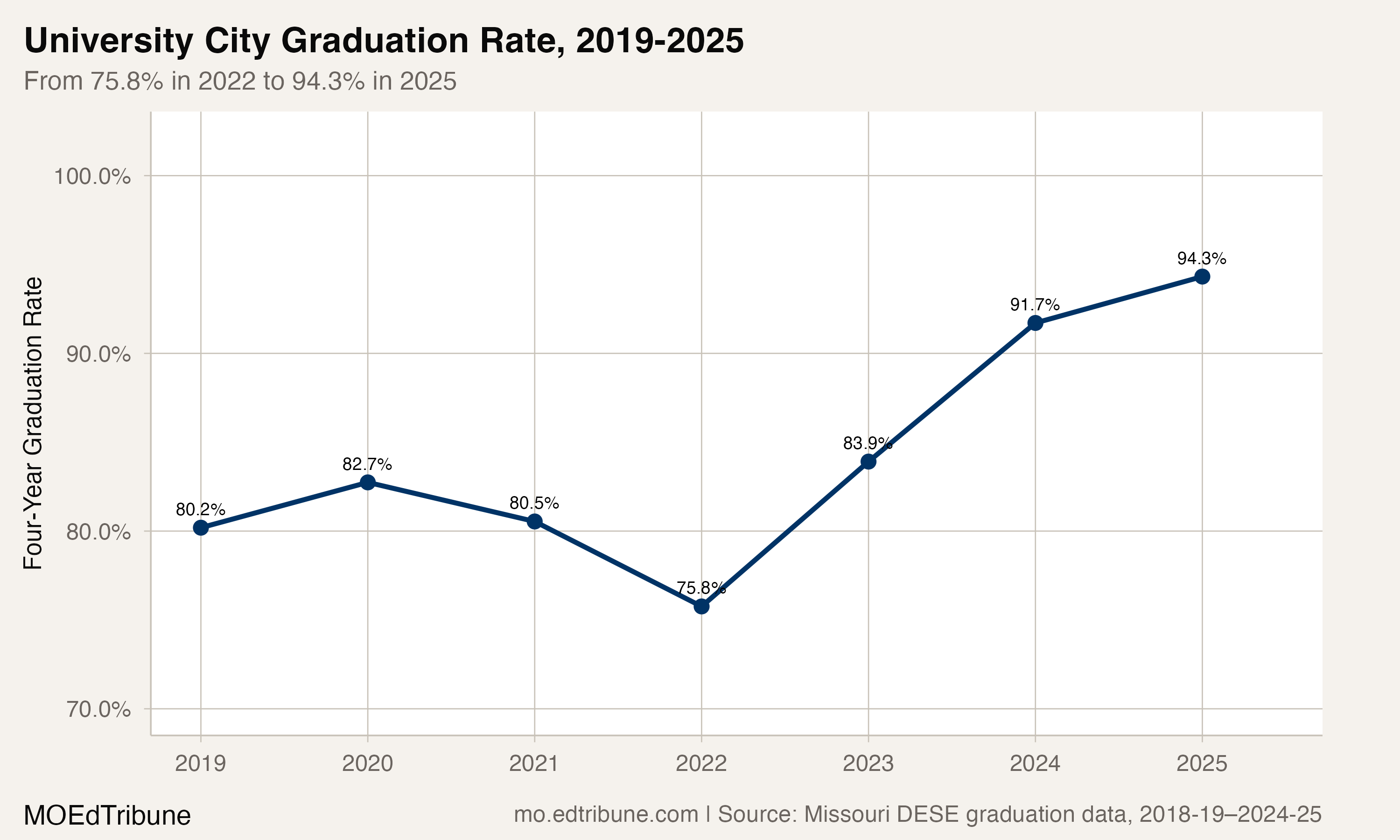
University City↗ET recorded its lowest rate in the available 2018-19–2024-25 adjusted-cohort graduation data in 2021-22: 75.8 percent. In 2024-25, 94.3 percent of its adjusted cohort graduated within four years.
That 18.6-point gain ranks first among 140 Missouri districts with at least 100 students in both the 2022 and 2025 four-year cohorts. It also moved University City 1.6 points above the statewide 2025 rate after every earlier year in the adjusted-cohort window had placed the district below Missouri's average.
This is a real turnaround in the data. The harder question is whether it is a new baseline.
The neighborhood context
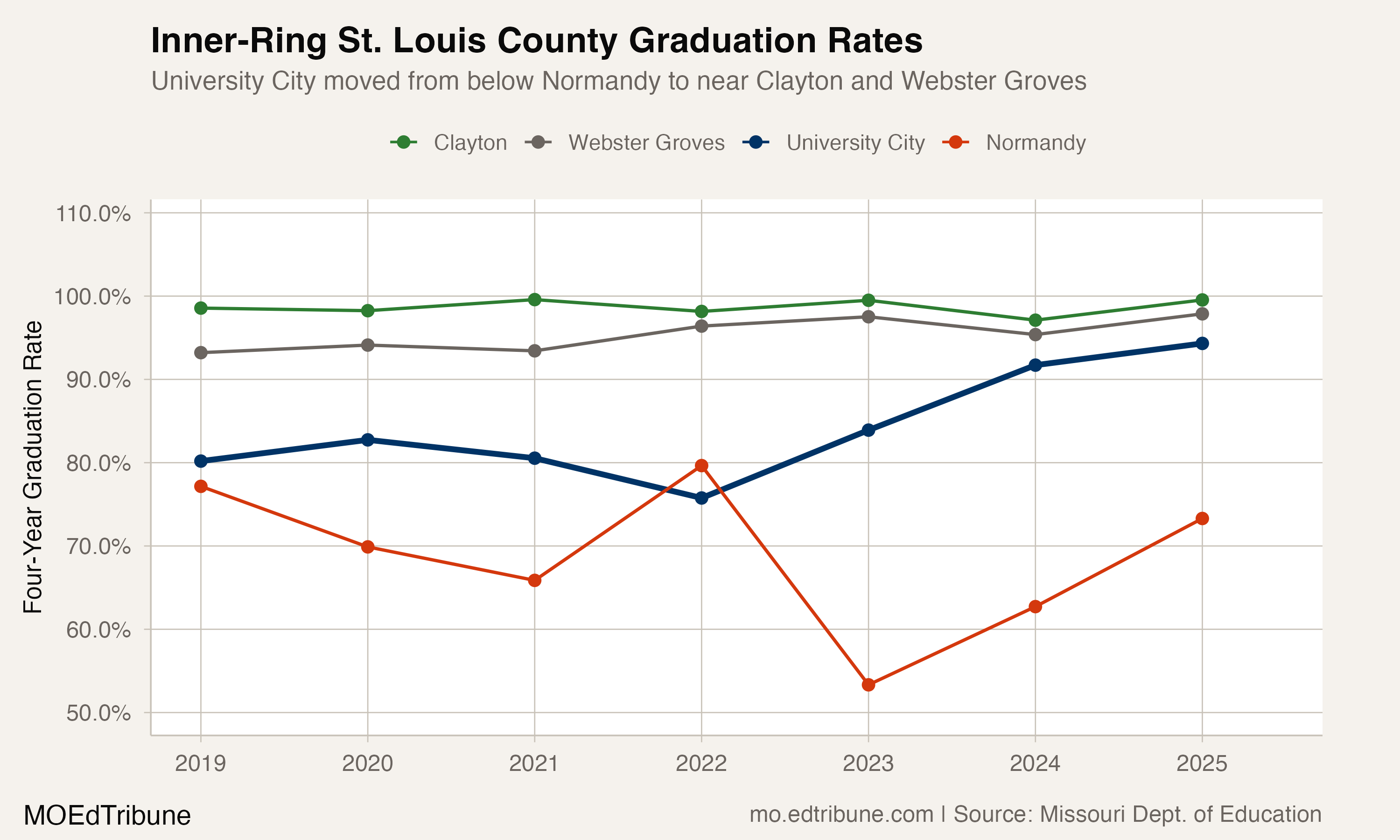
The comparison chart pairs University City with Clayton↗ET, Webster Groves↗ET and Normandy Schools Collaborative↗ET. In 2024-25, Clayton reported 99.5 percent, Webster Groves reported 97.9 percent and Normandy reported 73.3 percent.
The relationship flipped in three years. In 2022, University City was 3.9 points from Normandy, 22.4 points from Clayton and 20.6 points from Webster Groves. In 2025, it was 21.0 points above Normandy, 5.2 points behind Clayton and 3.6 points behind Webster Groves.
A meaningful cohort
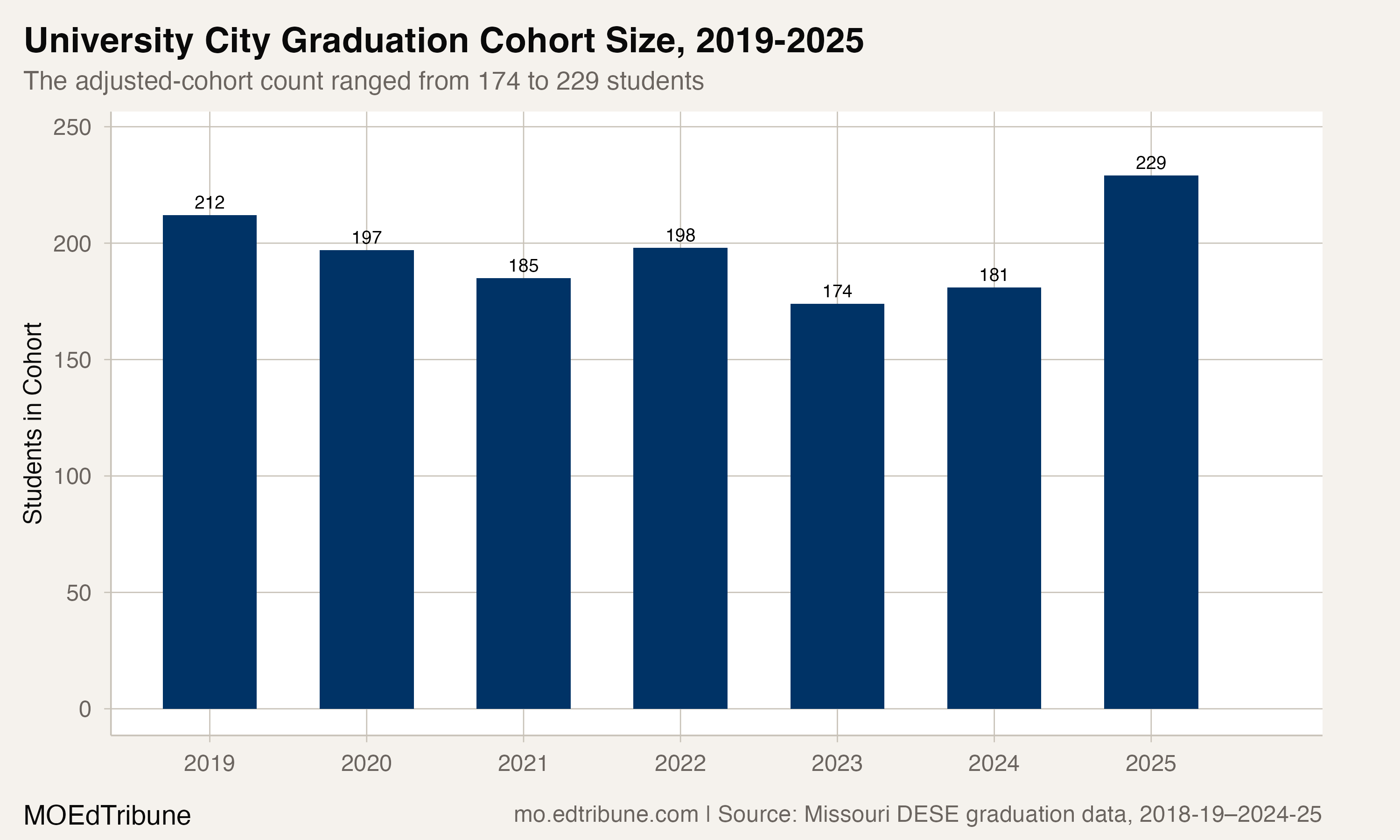
University City's 2025 four-year cohort had 229 students, and 216 of them graduated on time. In a hypothetical comparison holding the final adjusted-cohort denominator constant, moving from the 2022 rate of 75.8 percent to the 2025 rate of 94.3 percent is the equivalent of about 43 additional students finishing on time.
The cohort counts help define the scale of this comparison. University City's four-year cohort ranged from 174 to 229 students in the 2019-2025 adjusted-cohort window. The cohorts also differed in size: the 2022 cohort had 198 students, while the 2025 cohort had 229. That does not erase the 18.6-point gain; the rate change does not establish a single cause.
The volatility question
University City's recent path was not smooth. It stood at 80.2 percent in 2019, rose to 82.7 percent in 2020, slipped to 80.5 percent in 2021, then fell to 75.8 percent in 2022. The recovery came in steps: 83.9 percent in 2023, 91.7 percent in 2024 and 94.3 percent in 2025.
The largest gains came first: 8.2 points in 2023, then 7.8 points in 2024, then 2.6 points in 2025. That pattern is consistent with a district recovering from a low point, but it does not by itself identify what changed inside the district.
The state's adjusted-cohort file records that a rate moved. It does not record why.
What the district points to
The School District of University City answered questions from The MOEdTribune with written statements from three staff members, relayed through the district’s communications office on August 4, 2026. The statements describe counseling continuity and collaboration, which the graduation records do not measure.
Kimberly Merrill, the district's dual credit and early college counselor and department manager, wrote to The MOEdTribune that the change began well before the 2022 low. “During the 2018–2019 school year, the school counseling team shifted from a grade-level counseling model to a comprehensive counseling model based on students' last names. This change transformed the way school counselors served students and families. Rather than changing counselors each year, students were able to work with the same counselor throughout all four years of high school.” The team also “implemented a one-on-one meeting process that ensured every student met individually with their counselor each year.”
Nikole Shurn, the district's ROAR Academy director, wrote to The MOEdTribune that the alternative pathway now runs inside the high school rather than beside it. “One of the most significant changes has been our intentional collaboration with the traditional high school. Strong partnerships between school leadership, counselors, teachers, and support staff have helped create a seamless experience for students, regardless of the pathway they choose. Today, alternative education is no longer viewed as separate—it is recognized as another avenue to student success.” Students who finish through ROAR, she said, “are first and foremost our students.”
Superintendent Sharonica Hardin-Bartley put both inside the district's Learning Reimagined vision when she wrote to The MOEdTribune. “The collaborative efforts of the high school counseling and leadership teams humanized the high school experience, personalized pathways to success, and helped students create solutions to the problems that were barriers to their goals. Our vision, and our students’ and staffs’ collective efforts, are reflected in the data you see today.”
That is the district's own account, and it is the kind of account the graduation file cannot confirm or refute. What the file does show is that the recovery arrived in the classes that moved through a high school already running the counseling model Merrill describes.
The claim that passes the data check is narrower and still notable: from the 2022 cohort to the 2025 cohort, University City posted Missouri's largest graduation-rate gain among districts with at least 100 students in both graduating classes.
Analysis is based on graduation data from the Missouri Department of Elementary and Secondary Education's Missouri Comprehensive Data System.
Detailed code that reproduces the analysis and figures in this article is available exclusively to EdTribune subscribers.
Discussion
Sign in to join the discussion.
Loading comments...