Missouri's published enrollment figures show Springfield, Rockwood and Lee's Summit each enrolled fewer students in 2025-26 than in 2019-20. The 2025-26 counts are preliminary. They are the most recent year the state has published, not live counts for the 2026-27 school year.
Named district comparisons
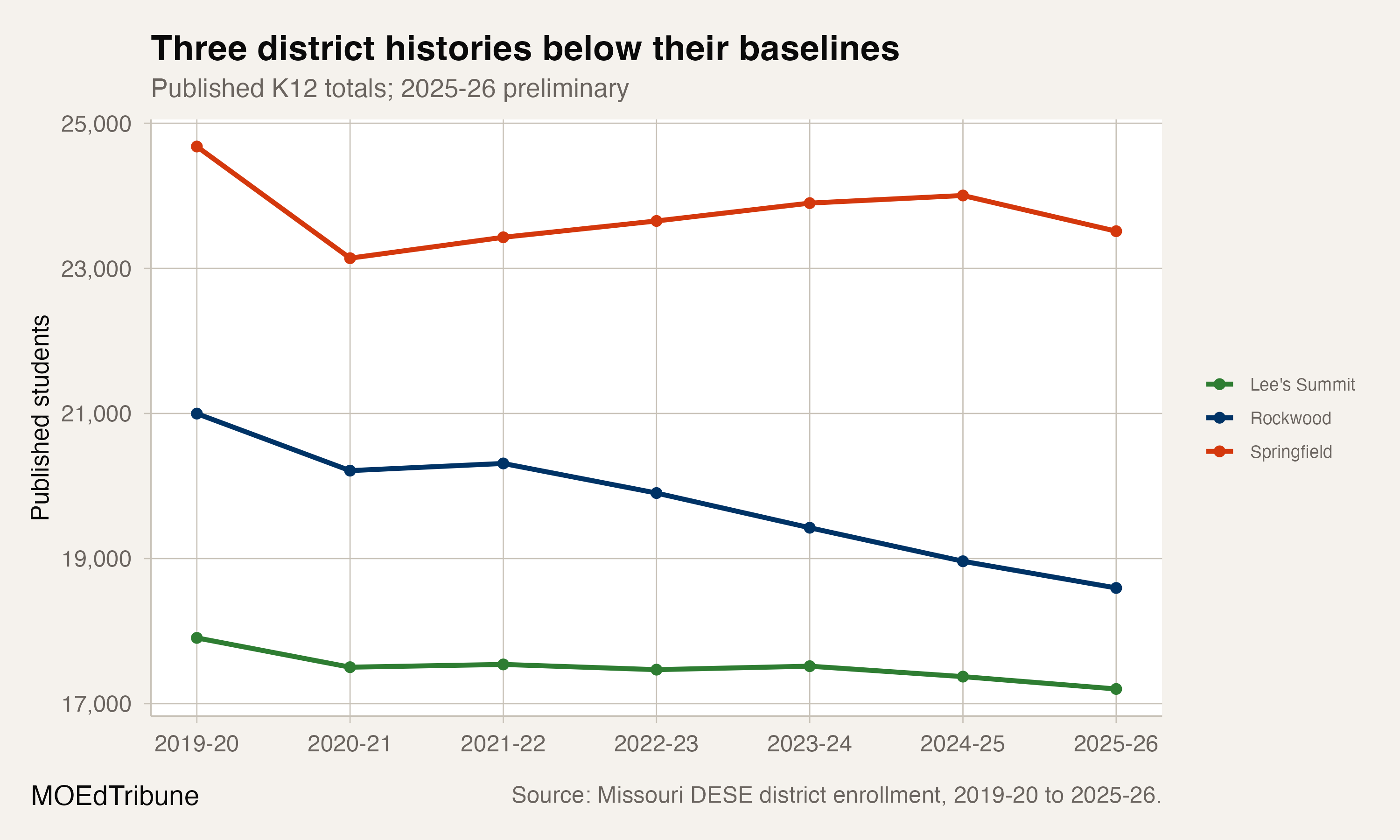
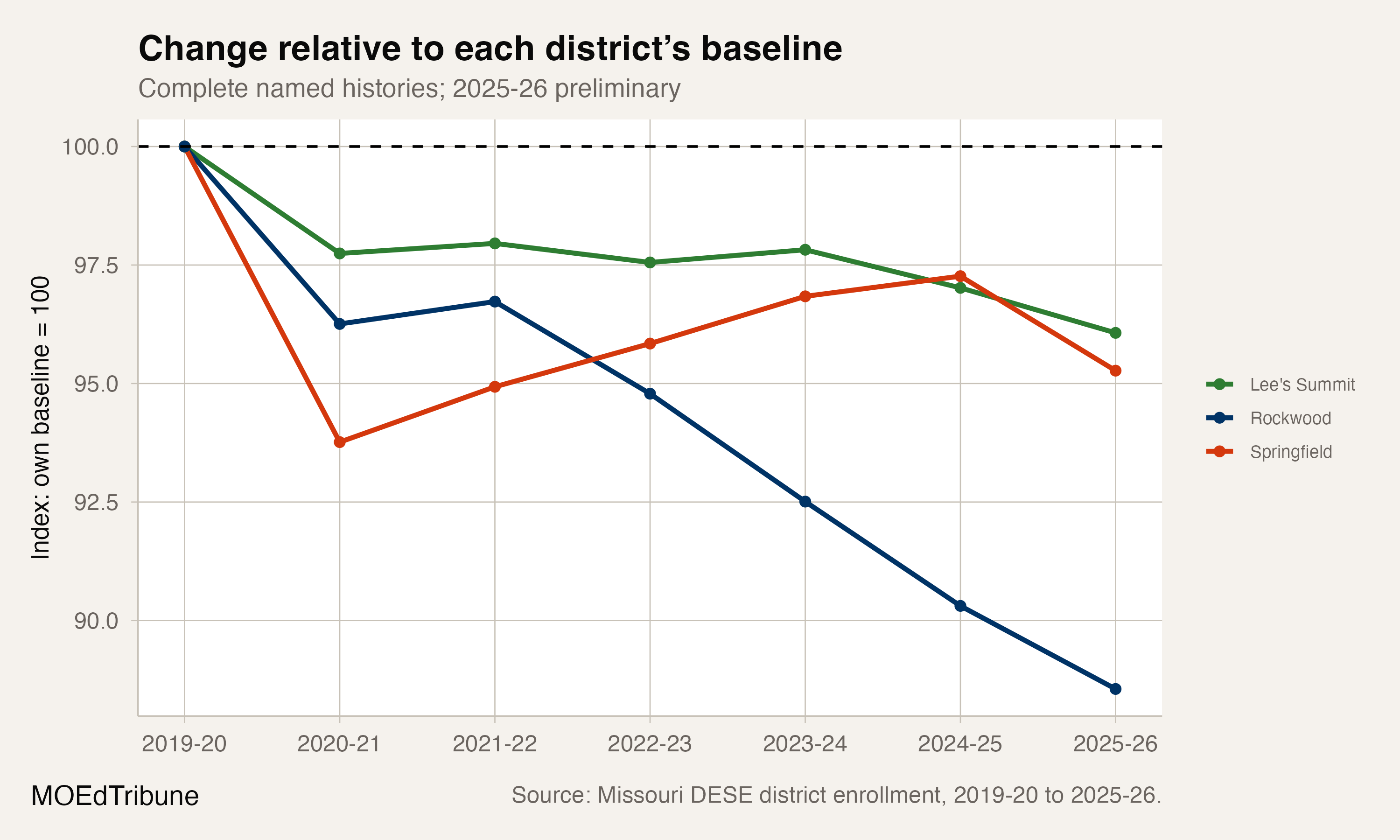
All three districts have a reported count in every year of the state's files, and all three were smaller in 2025-26 than in 2019-20. Rockwood↗ET lost 2,403 students, falling from 20,998 to 18,595, an 11.4% decline. Springfield↗ET lost 1,167, falling from 24,679 to 23,512, a 4.7% decline. Lee's Summit↗ET lost 704, falling from 17,907 to 17,203, a 3.9% decline.
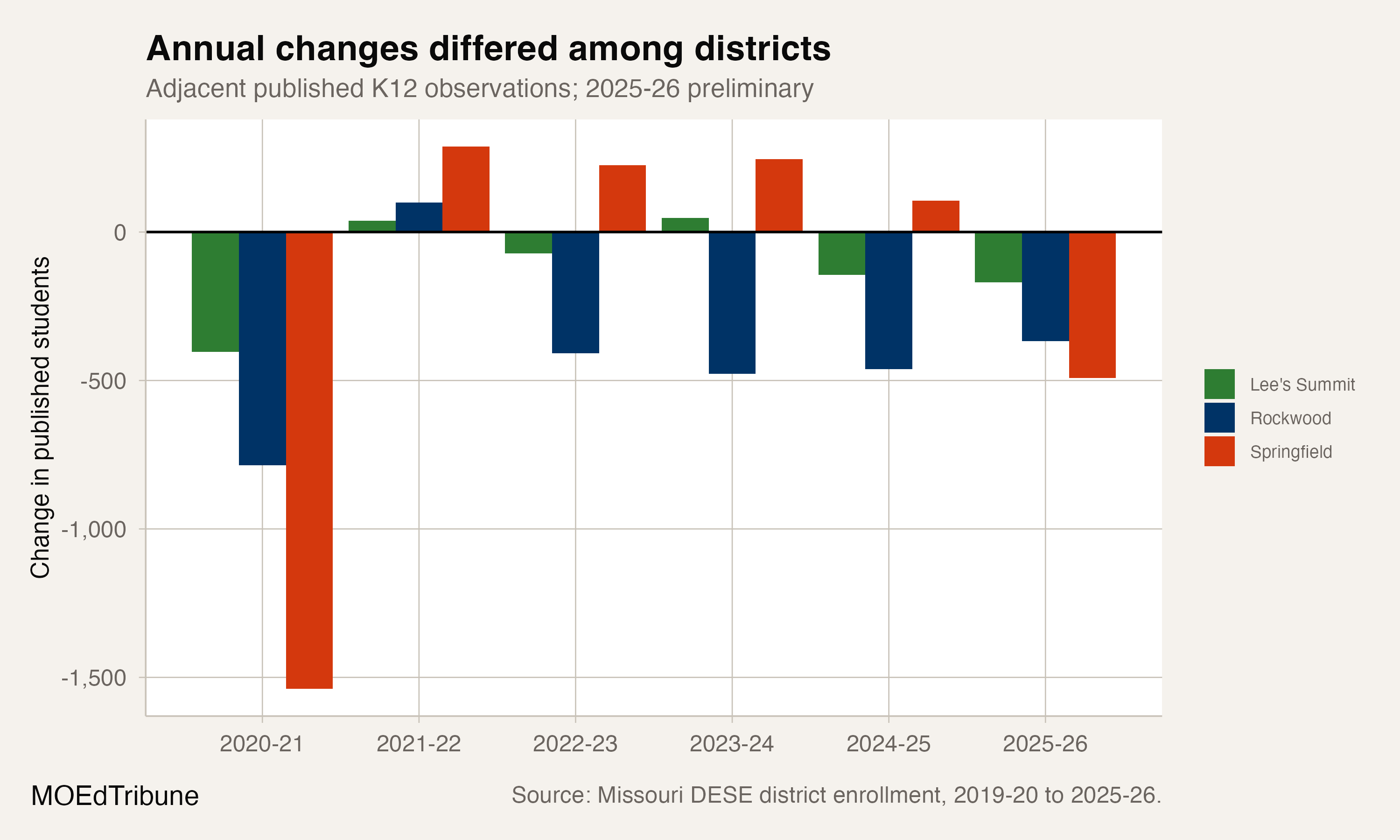
Springfield had the largest published total among the 558 districts with a reported count in 2025-26. Its path was not a straight line. It enrolled more students in 2024-25 than in 2020-21, then fell again in 2025-26.
Mary LaPak, Rockwood's chief communications officer, wrote in her June 26 response to The MOEdTribune, "For the 2025-2026 school year, our official K-12 enrollment was 18,566." That source-reported figure was slightly below the state preliminary figure of 18,595.
The district also keeps an official enrollment page. This article uses the state's file so that every district is measured the same way.
In the same response, LaPak said the district attributes part of its loss to the pandemic, "as some families transitioned to private or home-school." The larger force, in her account, is the size of each class: "Overall, the declining birth rate is causing kindergarten classes to be significantly smaller than graduating classes across the district. Therefore, we are seeing the decline in elementary grades first, and it will gradually work its way up through the secondary schools."
The state's file shows the gap she describes. Rockwood counted 1,095 kindergartners in 2025-26 and 1,643 seniors. In the same response, LaPak said a demographic study the district commissioned in 2024-25 found some variation across its high school attendance areas, but not a significant difference.
In a July 15 written statement forwarded by district communications staff, Springfield Superintendent Grenita Lathan said the district had been rightsizing its budget and staffing. She said it was conducting a demographic study and facility review to guide future decisions. These are the districts' own accounts, not findings from the enrollment data.
District responses on planning
Cyndee Byous, Rockwood's chief financial officer, said in the same June 26 response that the enrollment component a 2025 state law added to Missouri's school funding has "a relatively small impact on our district" because Rockwood's attendance rate has been above the state average. Because the district's decline has been gradual and spread across its schools, she said, it does not yet require any change in the number of schools Rockwood operates. "Any decreases in staffing are accomplished through attrition and we foresee no need to eliminate existing staff."
Byous wrote about the state budget in that June response: "The state’s failure to fully fund the existing state formula, uncertainties in the formula re-write that are expected to be presented to the legislature next session, and projections of continued shortfalls in the state’s revenue budget have a much higher impact on our budget and make planning for the future of the district more difficult."
The state's enrollment files do not show where students went, and they cannot show whether migration, birth rates or homeschooling drove the declines. The explanations above are the districts' own, given in June and July.
Published enrollment figures come from the Missouri Department of Elementary and Secondary Education’s historical district enrollment files and preliminary district enrollment files, using each district's published K-12 total. District quotations come from written responses to The MOEdTribune.
Detailed code that reproduces the analysis and figures in this article is available exclusively to EdTribune subscribers.
Discussion
Sign in to join the discussion.
Loading comments...