Correction (September 19, 2026): An earlier version of this article said two Missouri charter LEAs, Believe Academy STL and Friendly Academy, reported 0.0% chronic absence in 2024-25. Friendly Academy has no published rate for 2024-25; the 0.0% came from a data-processing error that recorded suppressed rates as perfect attendance. The same error affected the counts in this comparison. On the corrected data there are 37 charter LEAs, not 38, and 519 school districts, not 521. The charter median is 41.3%, not 40.0%, and the district median is 15.2%, not 15.1%. The top five charter rates, the trajectories and the 70.1-point charter range are unchanged.
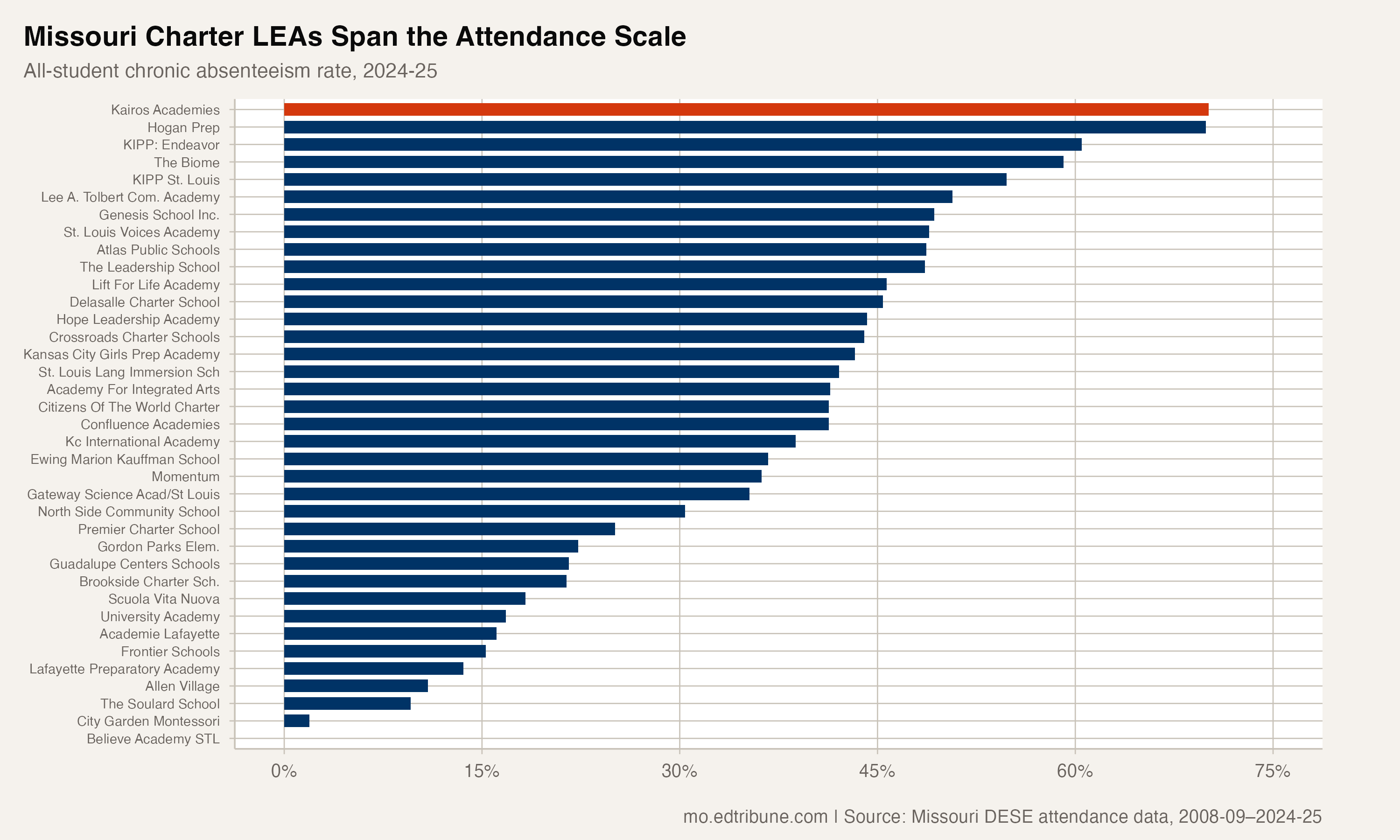
Missouri's 37 structurally identified charter local education agencies reported chronic absence rates from 0.0% to 70.1% in 2024-25. At the high end, Kairos Academies reported 70.1% and Hogan Preparatory Academy reported 69.9%. At the low end, Believe Academy STL reported 0.0% in its first year with a published rate, and City Garden Montessori reported 1.9%.
The current 2026-27 school year is not in this record. Missouri's most recent published district attendance data cover 2024-25.
The middle of the distribution is high
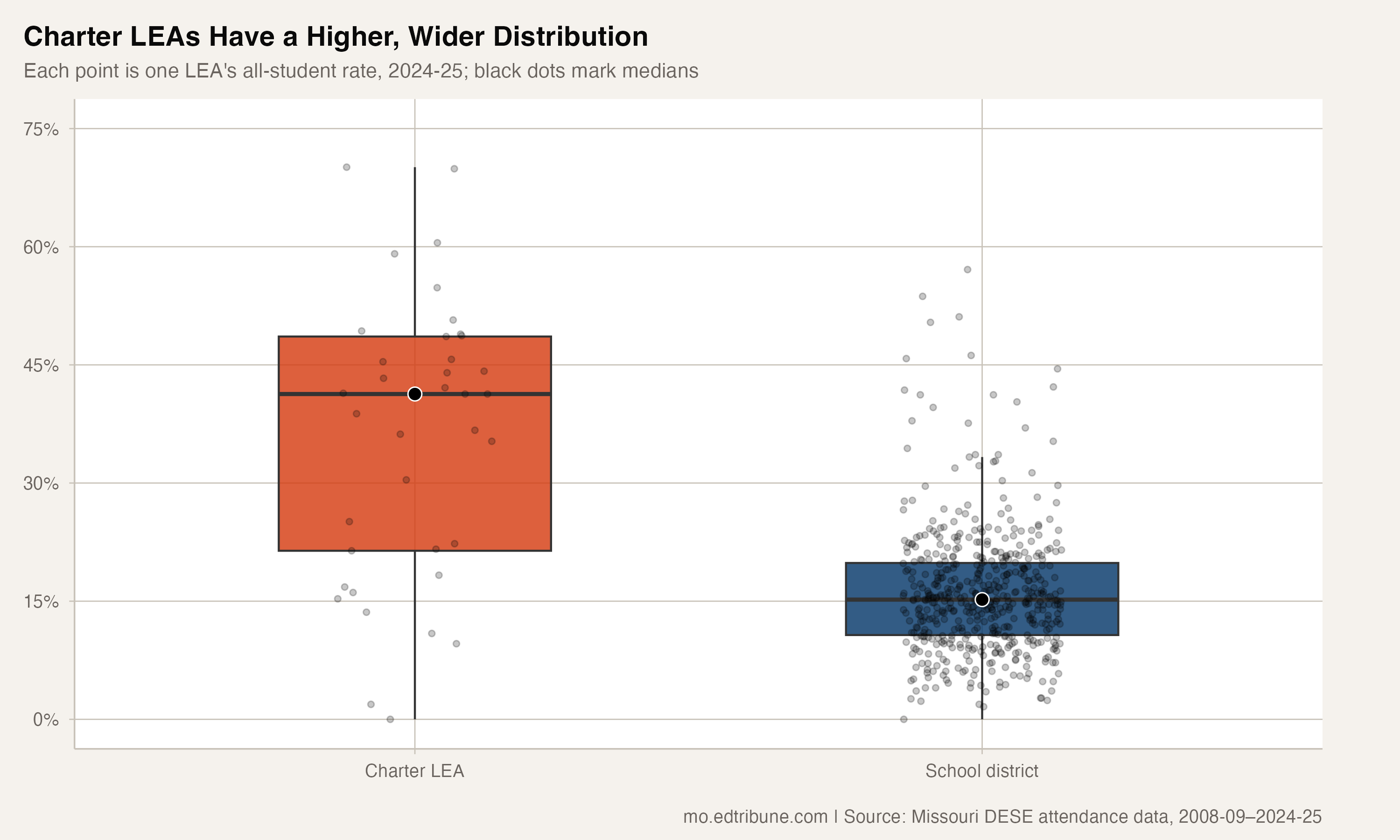
The charter median was 41.3%, compared with 15.2% among 519 structurally identified school districts. The charter median was 2.7 times the district median. The simple, unweighted means were 35.7% for charter LEAs and 16.1% for school districts.
Slightly more than half of the charter group, 19 of 37 LEAs, reported rates of at least 40.0%. That concentration matters as much as the endpoints: the comparison is not being driven by one high-rate organization.
The five highest charter LEA rates in 2024-25 were:
- Kairos Academies: 70.1%
- Hogan Preparatory Academy: 69.9%
- KIPP: Endeavor Academy: 60.5%
- The Biome: 59.1%
- KIPP St. Louis Public Schools: 54.8%
Those five occupy a narrow upper band, but they did not all arrive there by the same path.
Improvement and deterioration happened together
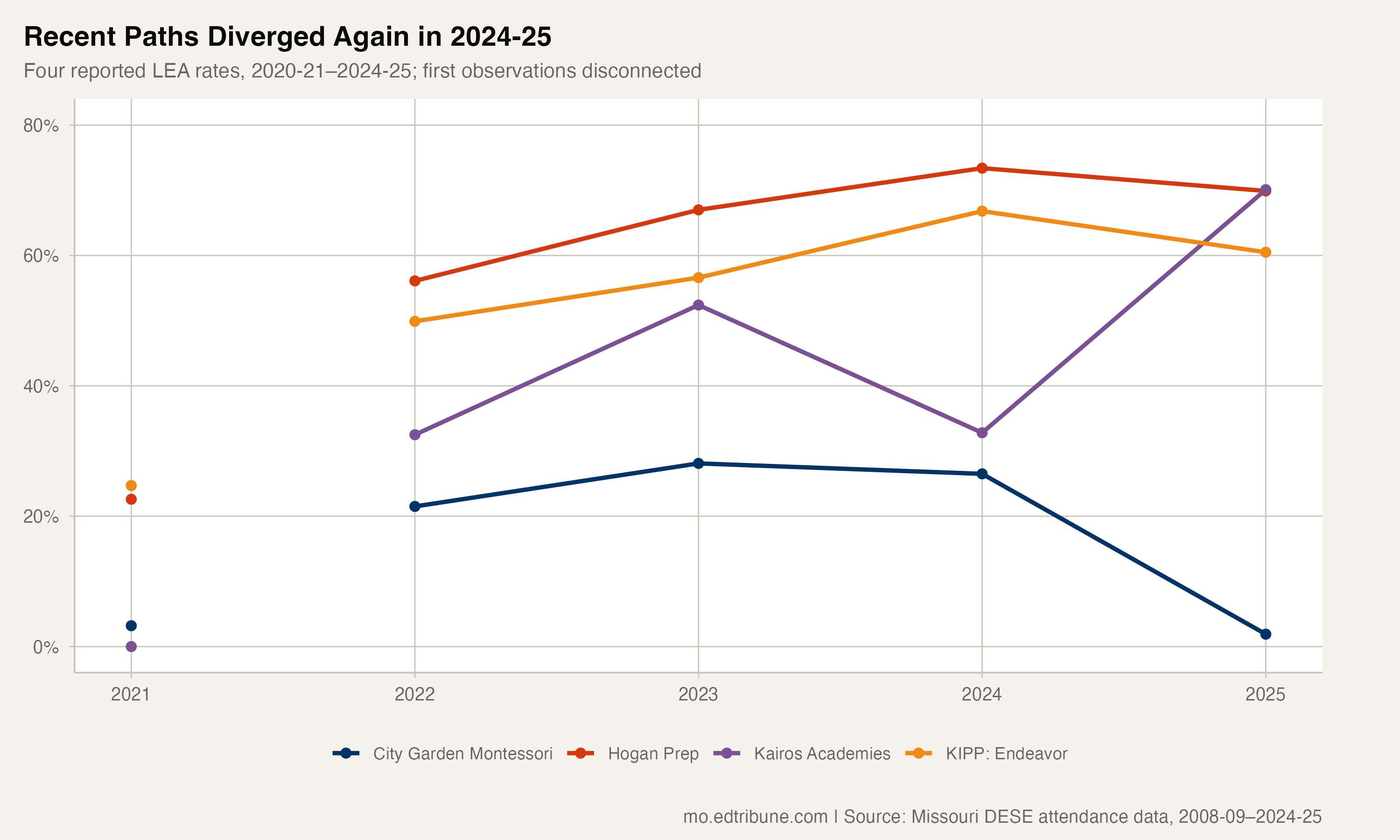
Hogan Prep's rate declined from 73.4% in 2023-24 to 69.9% in 2024-25, a 3.5-point improvement. KIPP: Endeavor also improved, from 66.8% to 60.5%, a 6.3-point change. Both rates remained among the sector's highest.
Kairos moved in the other direction. Its rate increased from 32.8% to 70.1%, a 37.3-point shift in one reporting year. City Garden Montessori offers the sharpest recent improvement among the LEAs shown in the trajectory chart: its rate fell from 28.1% in 2022-23 to 1.9% in 2024-25, a 26.2-point change.
What the comparison can and cannot say
The sector comparison uses Missouri DESE's reviewed county-district-code structure. It does not infer charter status from words such as "academy," "prep" or "Montessori." It also uses only the all-student rate for each LEA. Grade-band and lunch-eligibility subgroup rows are not treated as additional organizations, and an LEA whose rate was not published is left out rather than counted.
That produces a defensible comparison universe, but it does not explain the variation inside it. The attendance record does not identify instructional models, admissions behavior, family engagement, leadership practice or other mechanisms. It also gives each LEA one observation in the distribution regardless of enrollment size. The result is a comparison of reported LEA rates, not a student-weighted statewide charter rate.
The ordinary school-district range was 57.1 points, from 0.0% to 57.1%. The charter range was 13.0 points wider. The structural label therefore separates two distributions, but it does not reduce either one to a verdict about every school or student within it.
Attendance data come from the Missouri Department of Elementary and Secondary Education's Missouri Comprehensive Data System.
Detailed code that reproduces the analysis and figures in this article is available exclusively to EdTribune subscribers.
Discussion
Sign in to join the discussion.
Loading comments...