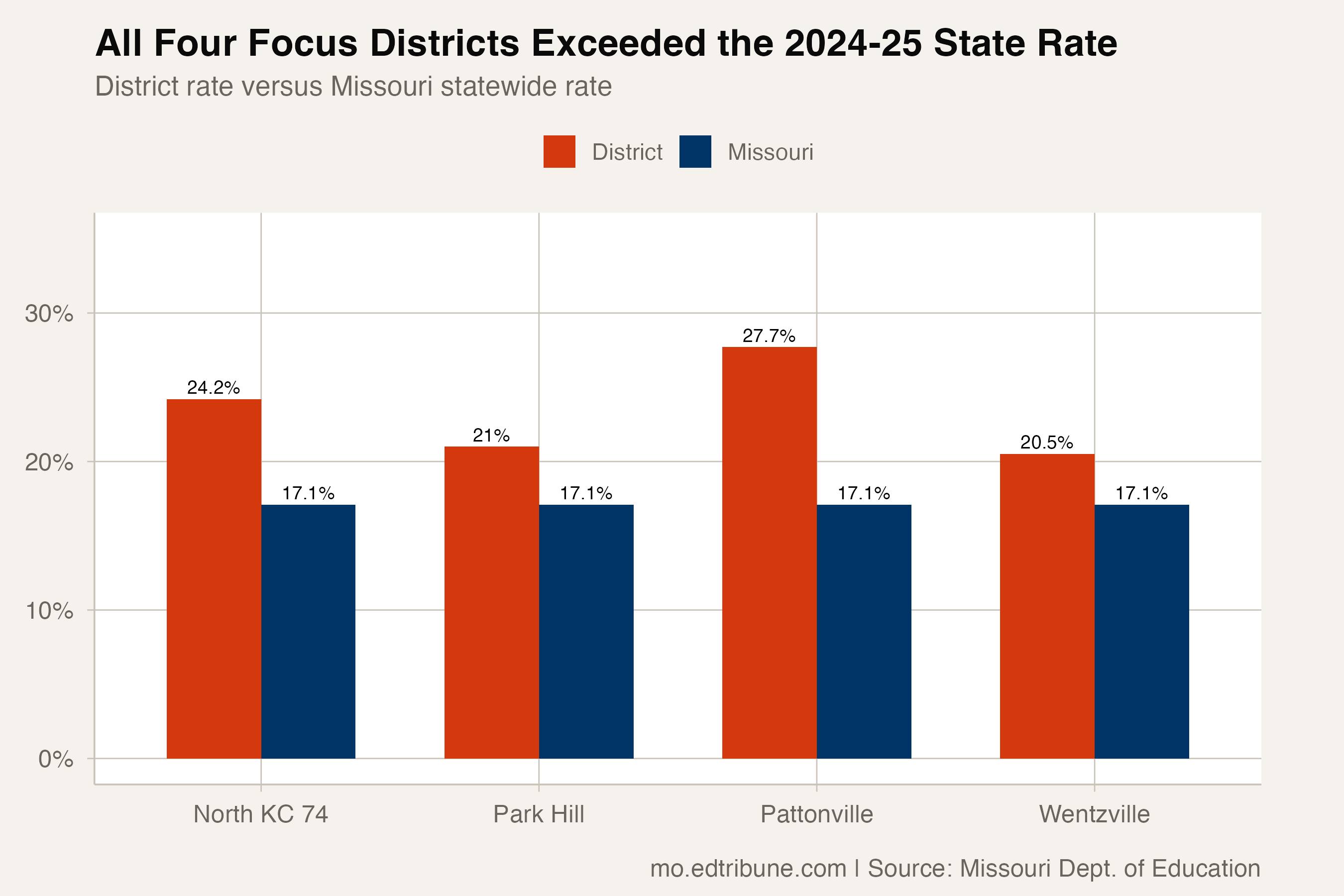
Correction (September 19, 2026): An earlier version of this article said Missouri's statewide chronic-absence rate was 17.1% in 2024-25 and that all four focus districts were above it. The 17.1% was an unweighted average of district rates, which counts a small rural district the same as a large suburban one. Missouri's published statewide rate for 2024-25 is 21.5%. North Kansas City and Pattonville were above it; Park Hill and Wentzville were just below it. The district rates reported here were not affected.
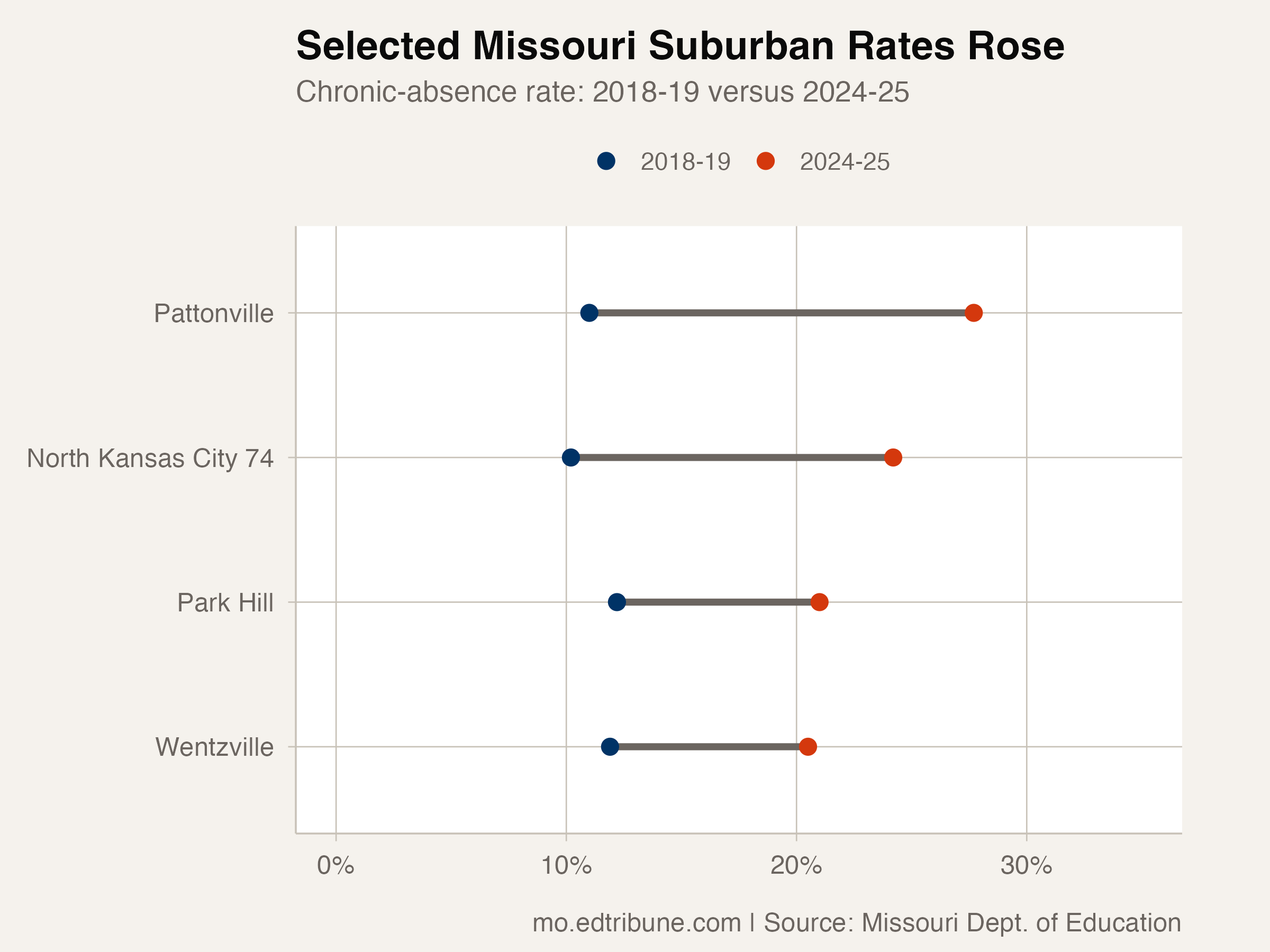
Missouri's chronic-absence data show large increases in four suburban districts between 2018-19 and 2024-25. North Kansas City↗ET rose from 10.2% to 24.2%, Pattonville↗ET from 11.0% to 27.7%, Wentzville↗ET from 11.9% to 20.5%, and Park Hill↗ET from 12.2% to 21.0%.
Two that are still getting worse
A 15-district screen found two districts whose 2024-25 rate was higher than in 2022-23. North Kansas City rose from 22.9% to 24.2%, a 1.3-point increase. Pattonville rose from 24.0% to 27.7%, a 3.7-point increase.
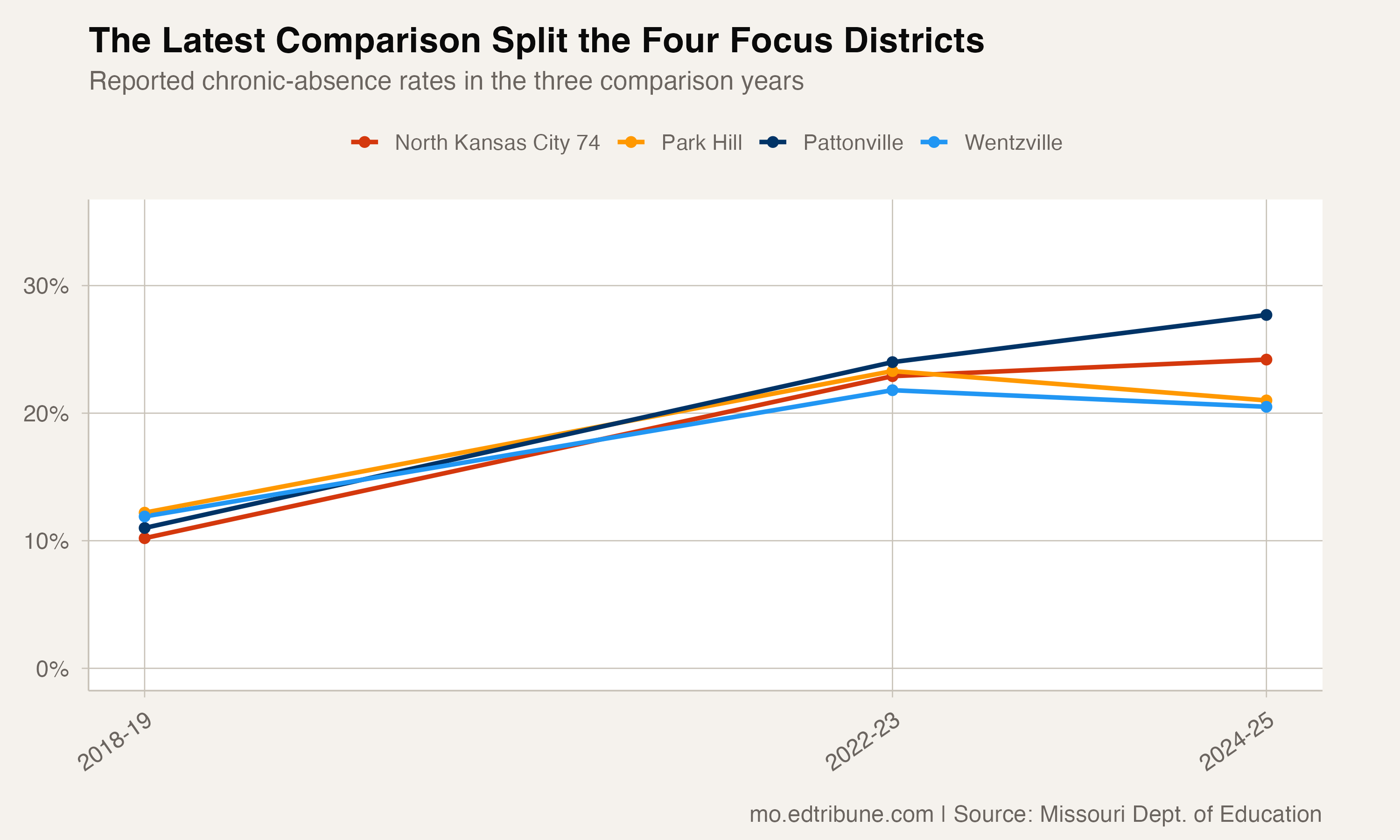
The other two focus districts improved over that latest comparison: Wentzville fell from its 21.8% 2022-23 rate to 20.5% in 2024-25, and Park Hill fell from 23.3% to 21.0%.
Measured against the statewide rate
Missouri's statewide chronic-absence rate was 21.5% in 2024-25. Two of the four focus districts were above it: Pattonville at 27.7% and North Kansas City at 24.2%. Park Hill, at 21.0%, and Wentzville, at 20.5%, were just below it.
The state's data establish the changes in reported chronic-absence rates. They do not identify which programs, student characteristics, family conditions, or community factors caused the changes, so this article makes no causal claim about the districts' performance.
Data source: Missouri Department of Elementary and Secondary Education.
Detailed code that reproduces the analysis and figures in this article is available exclusively to EdTribune subscribers.
Discussion
Sign in to join the discussion.
Loading comments...