Correction (October 8, 2026): The reported rates and ranking have been independently rechecked against the retained state records. This version clarifies what the attendance measures mean and what the records do not explain; the earlier corrections remain recorded in the article history.
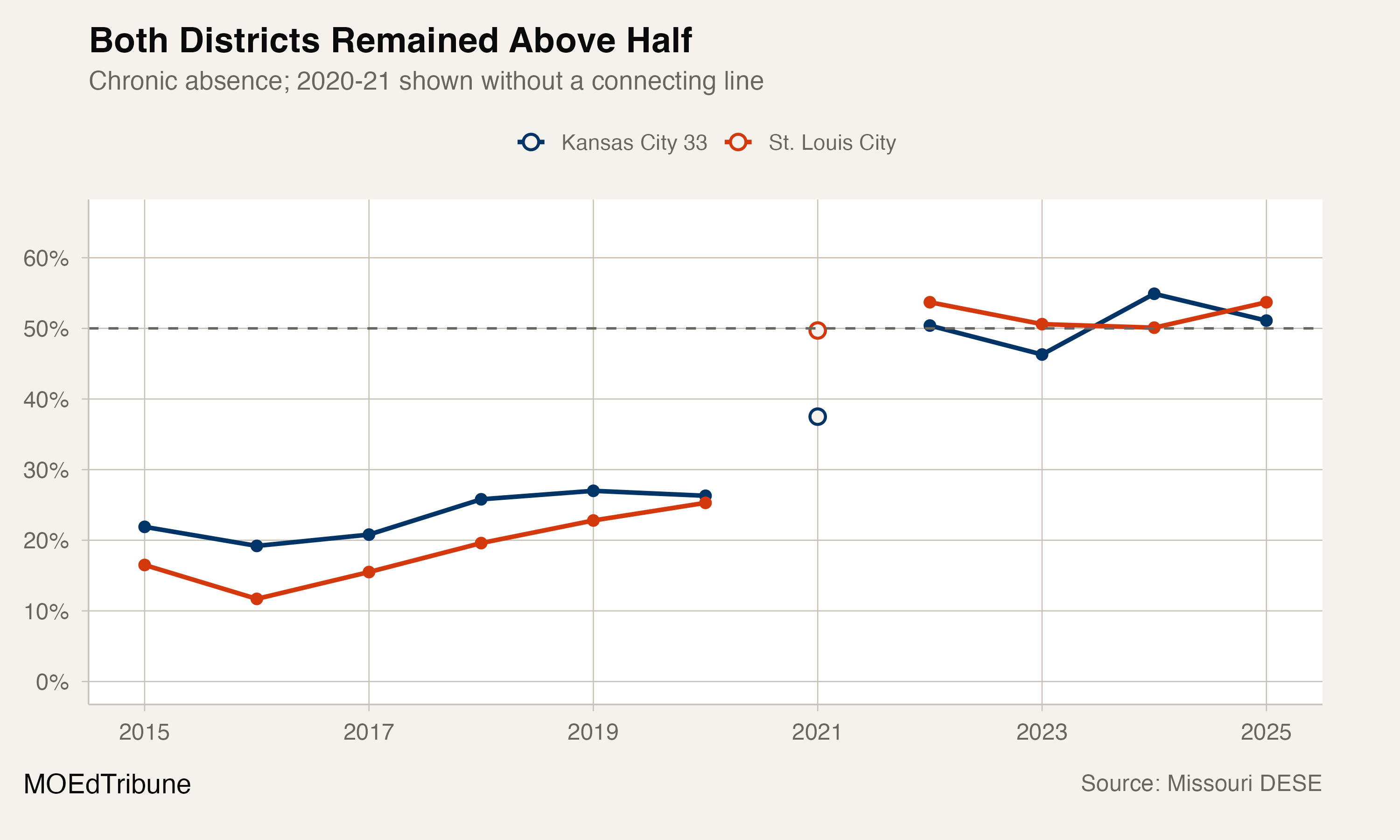
St. Louis City↗ET and Kansas City↗ET each reported chronic-absence rates above 50% for a second consecutive reporting year in 2024-25. St. Louis City's rate was 53.7%; Kansas City's was 51.1%.
Under the state's proportional-attendance definition, that means more than half of the students in each district met the chronic-absence measure. The margin above the arithmetic halfway point was 3.7 percentage points in St. Louis City and 1.1 points in Kansas City.
The PRiME Center’s explanation of Missouri attendance reporting describes proportional attendance as the proportion of students meeting the attendance threshold. The reported chronic-absence measure is its complement, rather than an average fraction of days missed.
The complete threshold history
The two districts had both been above 50% before. Each crossed the line in 2021-22: St. Louis City rose from 49.7% the prior year to 53.7%, while Kansas City moved from 37.5% to 50.4%.
Their paths then separated. St. Louis City stayed above 50% in every reporting year through 2024-25. Kansas City fell to 46.3% in 2022-23, moved to 54.9% in 2023-24 and finished at 51.1% in 2024-25. Across the full available panel, both districts were above half in three reporting years: 2021-22, 2023-24 and 2024-25.
The recent endpoints do not describe steady movement. St. Louis City was at the same 53.7% rate in 2021-22 and 2024-25, but its intervening values produced a 3.6-point high-low range and one direction reversal. Kansas City's endpoint rose 0.7 points across those years, while its path covered an 8.6-point range and reversed direction twice.
High-school rates were higher
The 2024-25 grade-band records show a larger chronic-absence rate among high-school students in both districts. Kansas City reported 68.6% for high school and 43.8% for K-8, a 24.8-point gap. St. Louis City reported 63.5% for high school and 50.0% for K-8, a 13.5-point gap.
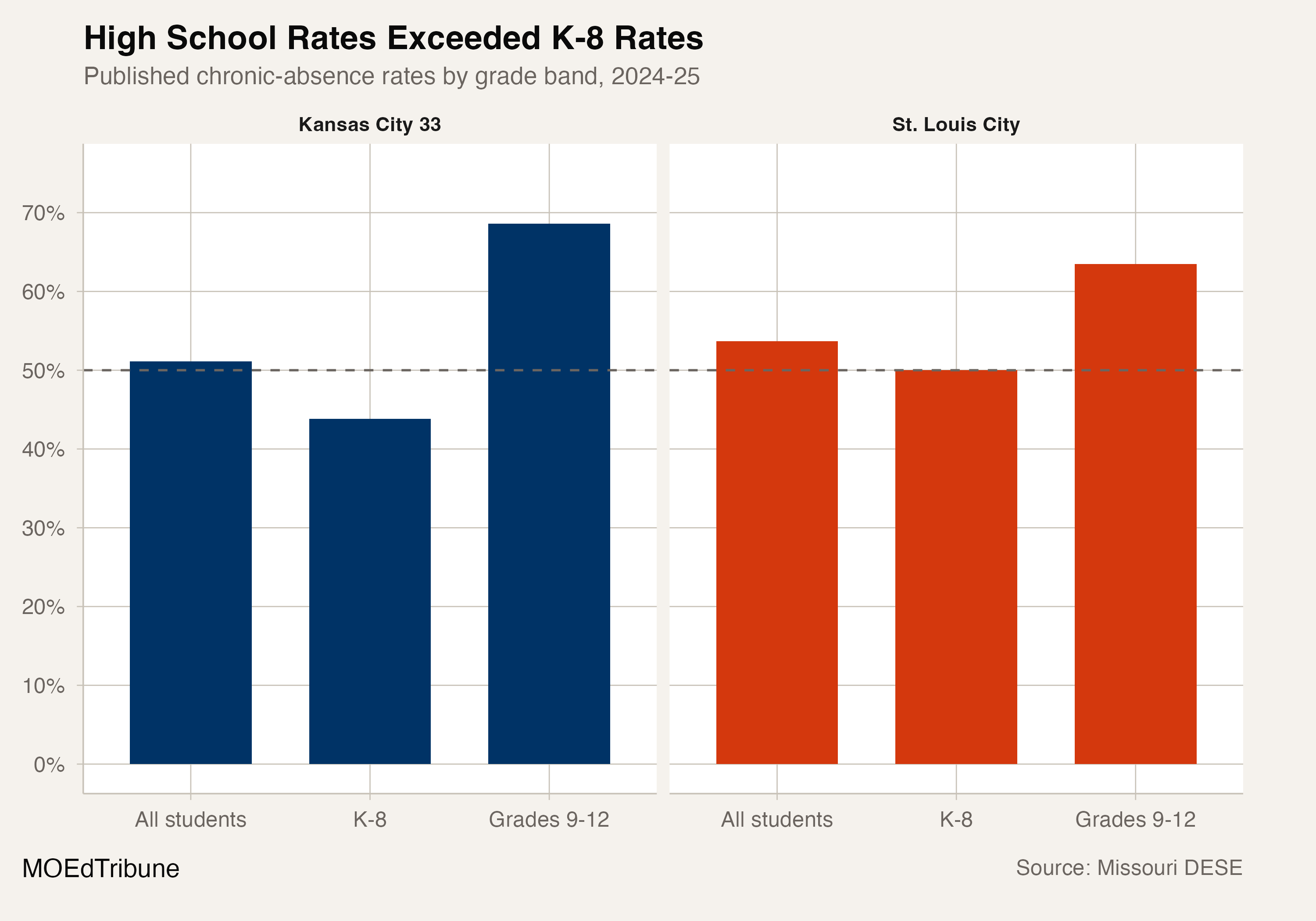
These are separately published grade-band rates, not parts of one whole. They show where each district's reported attendance problem was most concentrated without identifying why the difference exists.
Seventh and eighth among 557 districts
Among the 557 Missouri districts with a reported chronic-absence rate for 2024-25, St. Louis City had the seventh-highest overall rate and Kansas City had the eighth-highest. Eleven districts were at or above 50%.
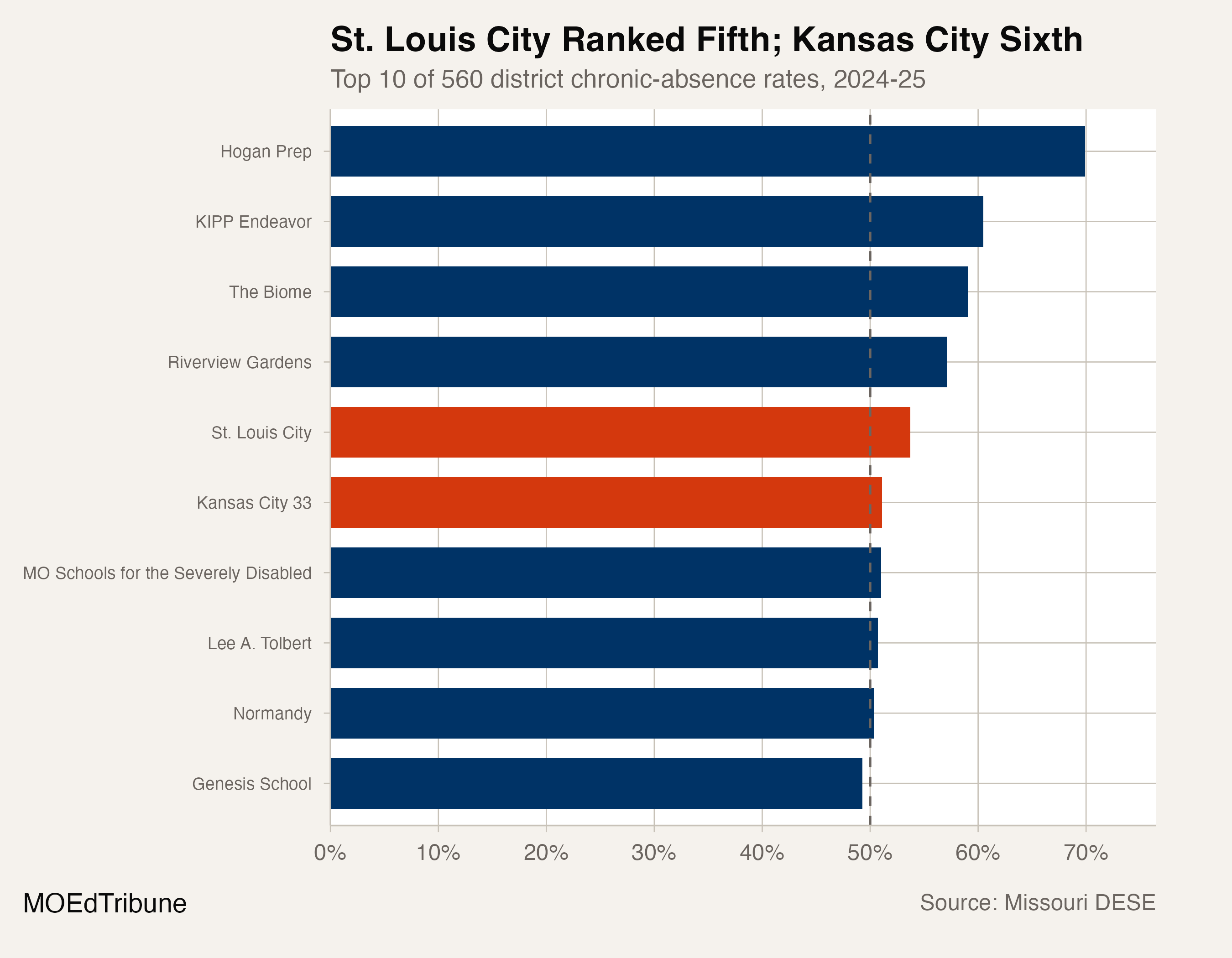
The ranking uses the all-students district rate and a tie-aware ordering. It does not classify districts by governance type or attempt to label a subset as “traditional,” distinctions the attendance records do not provide.
A longer endpoint comparison
St. Louis City's rate was 16.5% in 2014-15, 37.2 points below its 2024-25 value. Kansas City's rate was 21.9%, 29.2 points below its 2024-25 value.
Those endpoint differences cross a period with unusually large adjacent changes in the district records around 2020-21 and 2021-22. The analysis keeps the full history and flags those jumps rather than drawing a normal continuous trend through them. The endpoint comparison establishes that the latest rates were higher than a decade earlier; it does not establish a cause for the increase.
The attendance records do not identify why either district's rate was above half. Explanations involving transportation, housing, health, district operations or family circumstances require evidence beyond these rates. The 50% line is an arithmetic majority cutoff, not a policy threshold with an automatic operational consequence.
The verified finding is narrower: both urban districts remained above half for a second consecutive reporting year, and the grade-band records show that the high-school rates were higher still.
Detailed code that reproduces the analysis and figures in this article is available exclusively to EdTribune subscribers.
Discussion
Sign in to join the discussion.
Loading comments...