Rockwood R-VI↗ET peaked at 22,568 students in 2012. It was the kind of district that seemed insulated from the forces hollowing out Missouri's urban cores, a well-funded St. Louis County system with strong test scores and stable neighborhoods. In 2026, Rockwood enrolled 18,963 students, its lowest figure in the 26-year state dataset. It is not alone. Seven of its neighboring districts in St. Louis County are also at record lows.
Statewide, 174 of Missouri's 554 operating school districts recorded their all-time lowest enrollment in the 2025-26 school year, roughly one in three. The condition is not concentrated in one region or one type of community. It is everywhere.
The reach of the record
The most striking pattern in Missouri's all-time-low data is the absence of a pattern. Small rural districts are at record lows. So are large suburban ones. The share of districts at their floor is nearly identical across every size category: 34.6% of districts with fewer than 100 students, 35.0% of those with 500 to 999, and 35.3% of those with 10,000 or more.
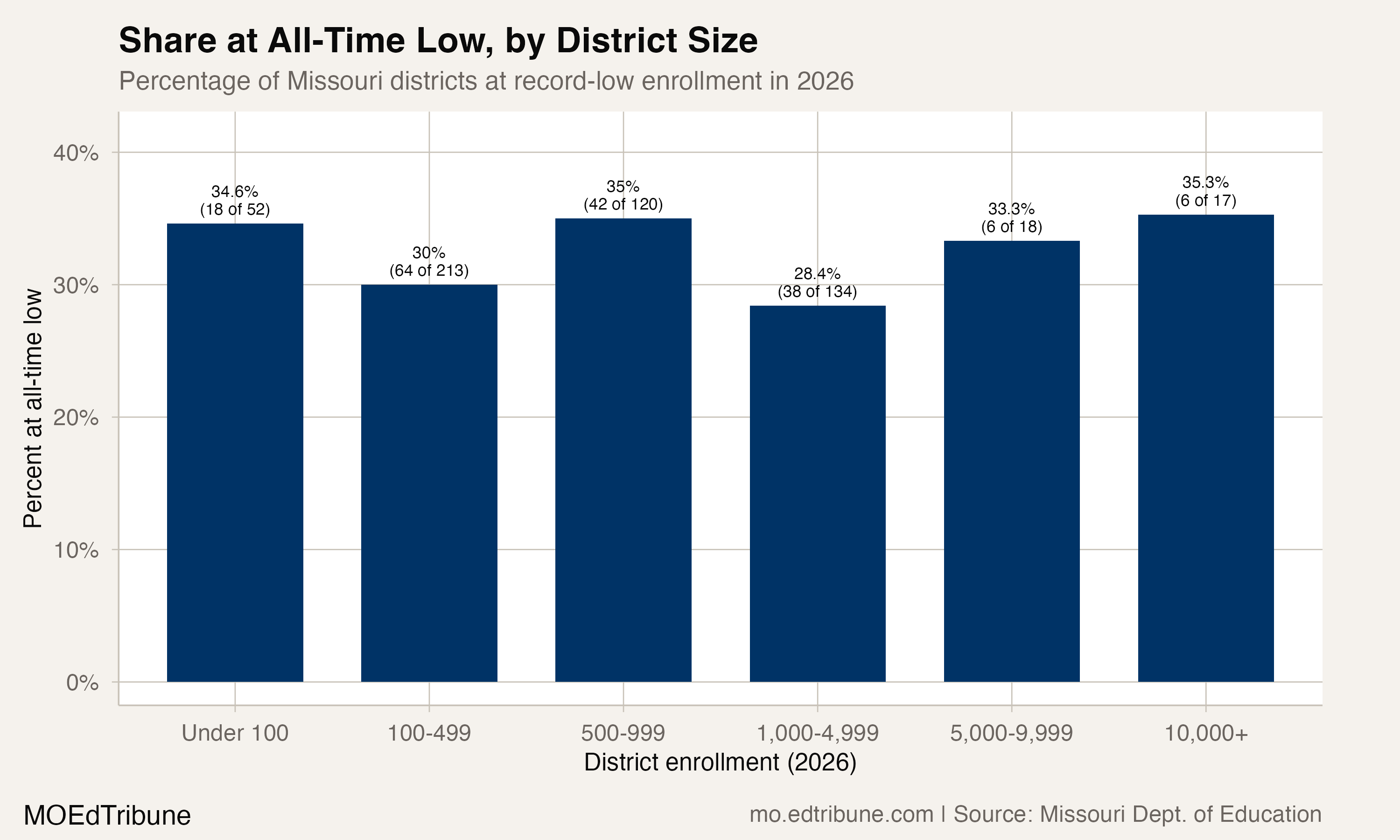
That uniformity means this is not a story about rural depopulation or urban flight. It is a structural shift affecting the state's entire public school system. The 174 districts at all-time low together enrolled 267,548 students in 2026, 31.3% of the state's total, down from a combined peak of 362,483. That is 94,935 students gone.
At the other end, 35 districts reached all-time highs in 2026, enrolling a combined 96,643 students, 11.3% of the state total. Three of those, Grandview R-II, Sturgeon R-V, and Laquey R-V, owe their records to virtual enrollment surges after HB 1552 removed the resident-district approval requirement for full-time virtual schooling in 2022.
St. Louis County's inner ring
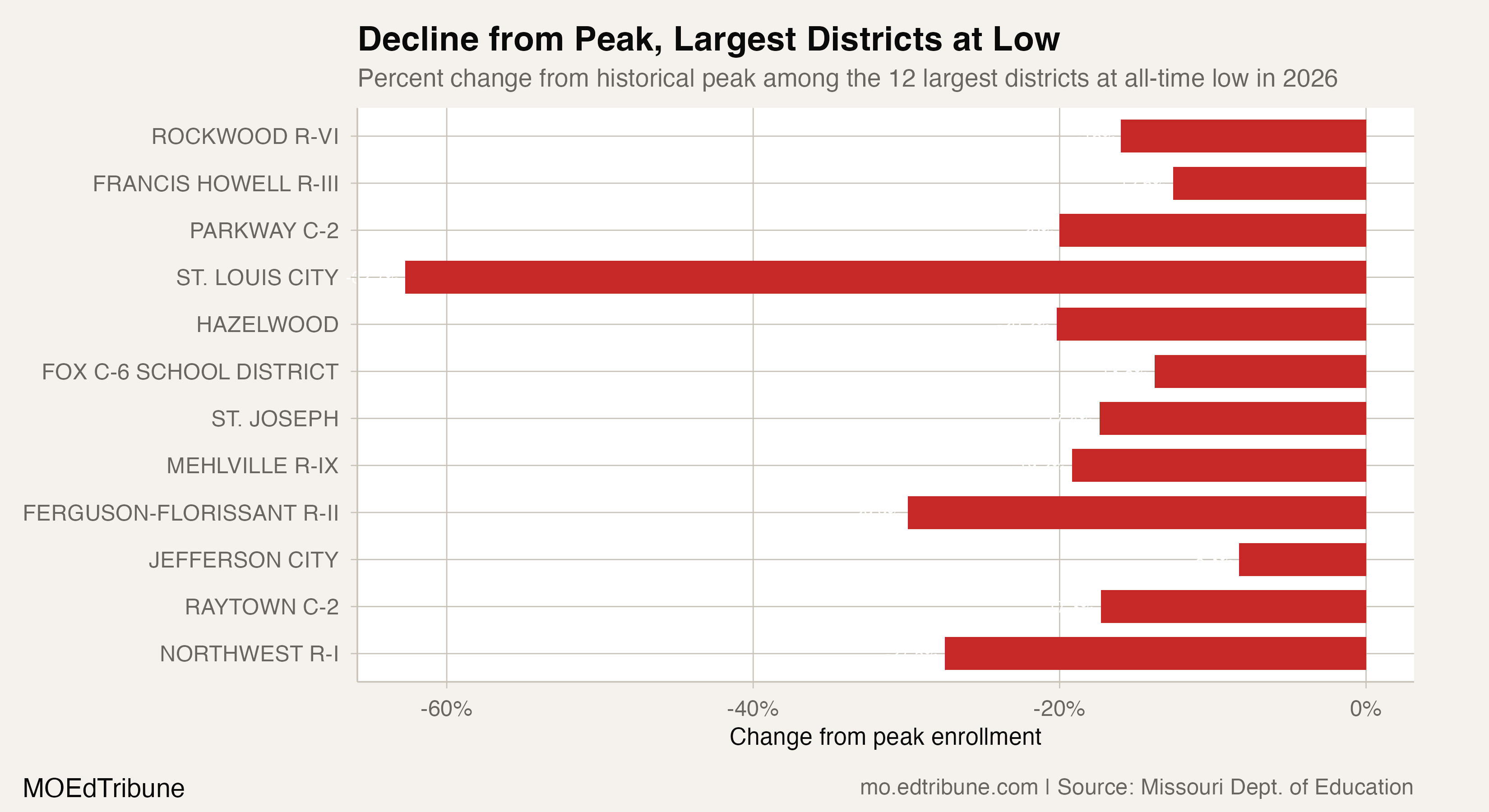
The largest districts at all-time low read like a roster of St. Louis County's established suburbs. Parkway C-2↗ET, once a 20,547-student district, is down to 16,430, a 20.0% decline. Hazelwood↗ET has lost 20.2% from its 2007 peak. Ferguson-Florissant R-II↗ET, which enrolled 12,319 students that same year, is at 8,641, a 29.9% drop. Francis Howell R-III↗ET, further west in St. Charles County, peaked at 18,832 in 2001 and now enrolls 16,466.
The districts losing students and those gaining them often sit within the same metro. North Kansas City 74↗ET, at an all-time high of 20,915, is 15 miles from Raytown C-2↗ET, at an all-time low of 7,423. Wentzville R-IV↗ET, which has tripled from 5,742 to 17,538 since 2001, is in the same county as Francis Howell, which peaked that same year and has declined ever since.
The dynamic is a textbook enrollment donut. Families move outward from city to inner suburb to exurb, and each ring's schools peak and then decline as the next ring absorbs growth.
Two Missouris, widening
When the 174 districts at all-time low are tracked as a group and compared against the 35 at all-time high, the gap between them has widened every year since 2005.
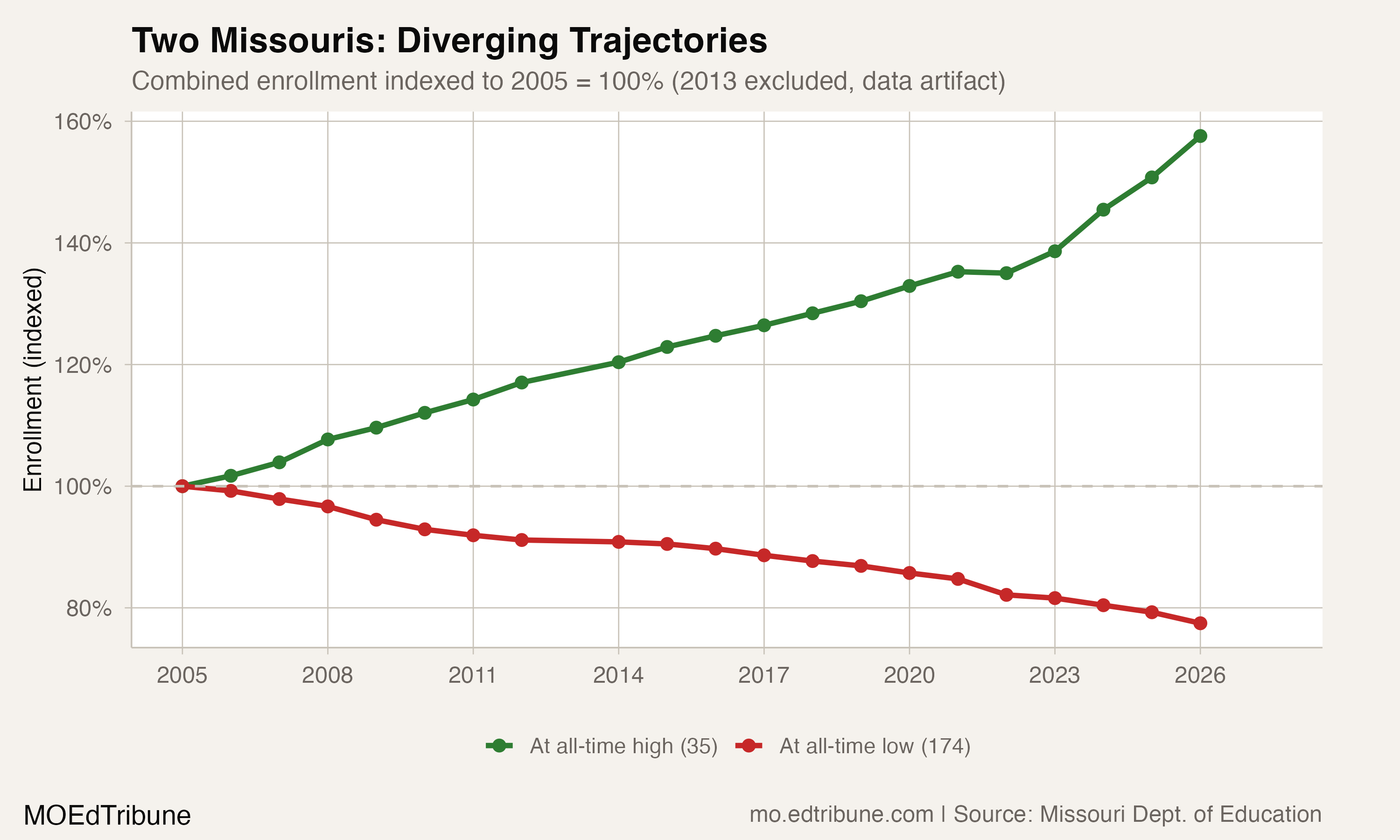
Combined enrollment in the all-time-high group has grown by more than 50% since 2005. The all-time-low group has shrunk by more than 20%. The trajectories have not converged in any year. The gap is not cyclical. It is structural, and it is accelerating: since 2022, the declining group's losses have outpaced the growing group's gains by a widening margin.
The 2022 inflection
The year 2022 was when Missouri's enrollment map cracked. Statewide enrollment fell by 20,068 students, the largest single-year decline in the dataset, and 198 districts, the most in any year, were at their all-time low.
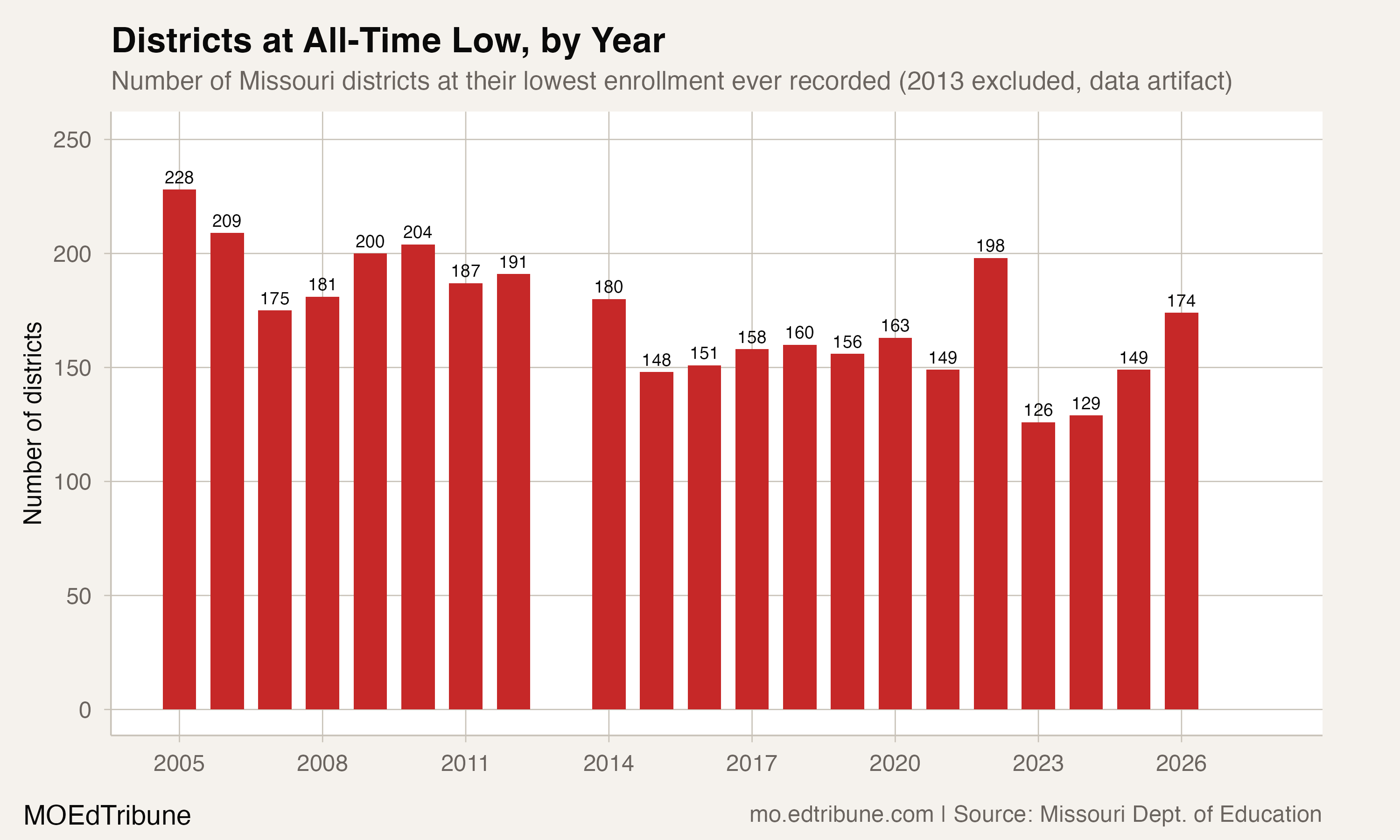
That count retreated to 126 by 2023 as some districts bounced modestly, but it climbed again: 129 in 2024, 149 in 2025, 174 in 2026. The 2022 cliff was not a single bad year. It was the beginning of a new era in which record-setting lows became normal for a third of the state.
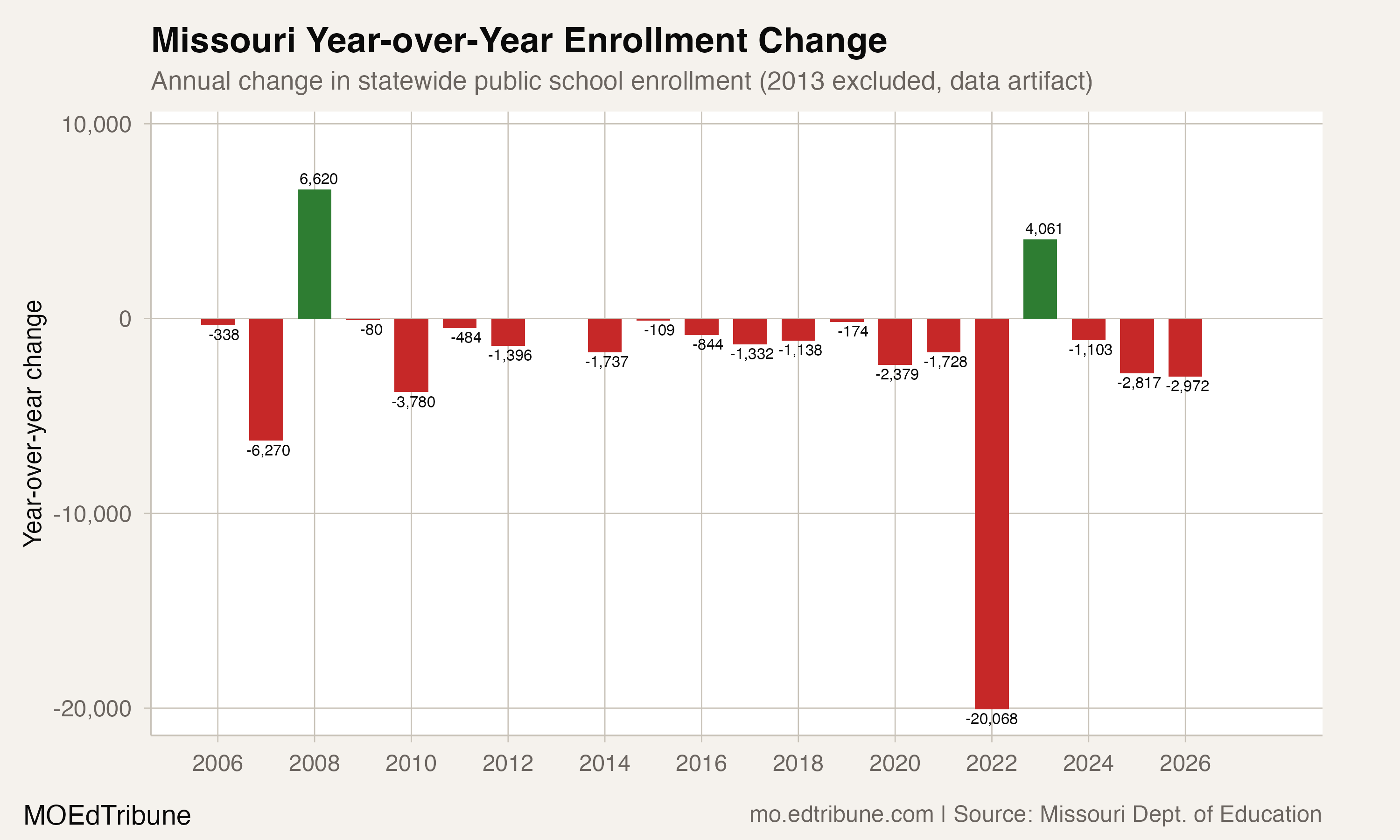
Multiple forces converged. Missouri's birth rate has been falling for more than a decade. The number of births continues to drop even after abortion restrictions took effect. The pandemic accelerated homeschooling, which doubled in Missouri to roughly 61,000 students by 2024. Colin Hitt, executive director of Saint Louis University's PRiME Center, noted the permanence of the shift:
"One might think that this was a temporary bounce during and after the pandemic, but we're not seeing that at all and right now, this looks like a huge shift, and all signs are that it's permanent." -- STLPR, Dec. 2024
Those 61,000 homeschooled children equal the combined enrollment of St. Louis City and Kansas City public schools, according to PRiME Center research published in the Journal of School Choice.
The districts that cannot stop falling
Some districts have been at or near their all-time low not just in 2026 but for most of the past decade. Northwest R-I↗ET, a Jefferson County district south of St. Louis, has been at its cumulative floor in every one of the last 12 years, falling from 7,720 to 5,599. Trenton R-IX↗ET in rural Grundy County has held that distinction for 11 straight years, shrinking from 1,294 to 970. St. Joseph↗ET, once a 12,098-student district, has been declining for 10 consecutive years and now enrolls 9,988.
In the state's Bootheel region, Caruthersville 18↗ET has been at its all-time low for eight straight years, dropping from 1,605 to 878 as the cotton and soybean economy that sustained this Mississippi River town continued to contract.
St. Louis City↗ET itself, the most extreme case, has lost 27,209 students since 2001, a 62.7% decline, falling from 43,420 to 16,211. The district is now considering closing 37 of its 68 schools because its buildings sit at roughly 52% average capacity. The $1.8 billion estimated repair backlog on those 79-year-old buildings makes the math straightforward, even if the community impact is not.
What the funding formula does not see
Missouri is reviewing its school funding formula for the first time through a School Funding Modernization Task Force created by Governor Kehoe's Executive Order 25-14, with recommendations due by December 2026. The current formula's property tax model has been frozen at 2005 levels, and roughly 200 of the state's 518 districts are held harmless to their 2005-06 funding amounts.
That hold-harmless provision was designed for a different enrollment landscape. When 174 districts are at all-time lows and the trend is accelerating, a formula built to prevent sudden drops may instead be masking the fiscal erosion happening underneath. Seventy percent of Missouri's school districts are classified as rural, but combined they serve just 21% of the state's students. For those districts, losing five or 10 students in a year does not look dramatic in state data. It means one fewer section of third grade, a reading specialist position that cannot be justified, a bus route eliminated.
Normandy Schools Collaborative↗ET, the north St. Louis County district whose accreditation crisis in 2013 triggered the state's school transfer law, enrolled 5,961 students at its peak and now has 2,589. Jennings↗ET, its neighbor, has fallen from 3,325 to 2,130. Both are at all-time lows. Neither has a suburban growth ring to absorb spillover. The students who leave do not move to the next ring; they leave the system.
What comes next
The 35 districts at all-time highs offer the nearest counterweight, but three of those are virtual enrollment artifacts. Strip those out and the organic growth districts — North Kansas City, Nixa, Troy, Republic, Platte County — serve roughly 96,000 students combined. The 174 districts at all-time lows serve 268,000 and shrink. Missouri has 554 school districts, an open-enrollment bill that has cleared the House five years running without becoming law, and a statewide enrollment of 855,081 that is itself an all-time low. The math is not trending toward equilibrium. It is trending toward consolidation, whether Missouri's legislature acts on it or not.
Detailed code that reproduces the analysis and figures in this article is available exclusively to EdTribune subscribers.
Discussion
Sign in to join the discussion.
Loading comments...